基于DNA宏条形码研究四川老君山国家级自然保护区6种同域共存小型哺乳动物的食性
- 四川师范大学生命科学学院, 成都 610101
收稿日期: 2022-08-18
录用日期: 2022-11-24
网络出版日期: 2023-01-01
基金资助
国家自然科学基金青年项目(32001223);四川省自然科学基金青年基金(2022NSFSC1711);成都市科技项目重点研发支撑计划(2021-YF05-01552-SN)
DNA metabarcoding dietary analysis of six sympatric small mammals at the Laojunshan National Nature Reserve, Sichuan Province
- College of Life Sciences, Sichuan Normal University, Chengdu 610101
Received date: 2022-08-18
Accepted date: 2022-11-24
Online published: 2023-01-01
摘要
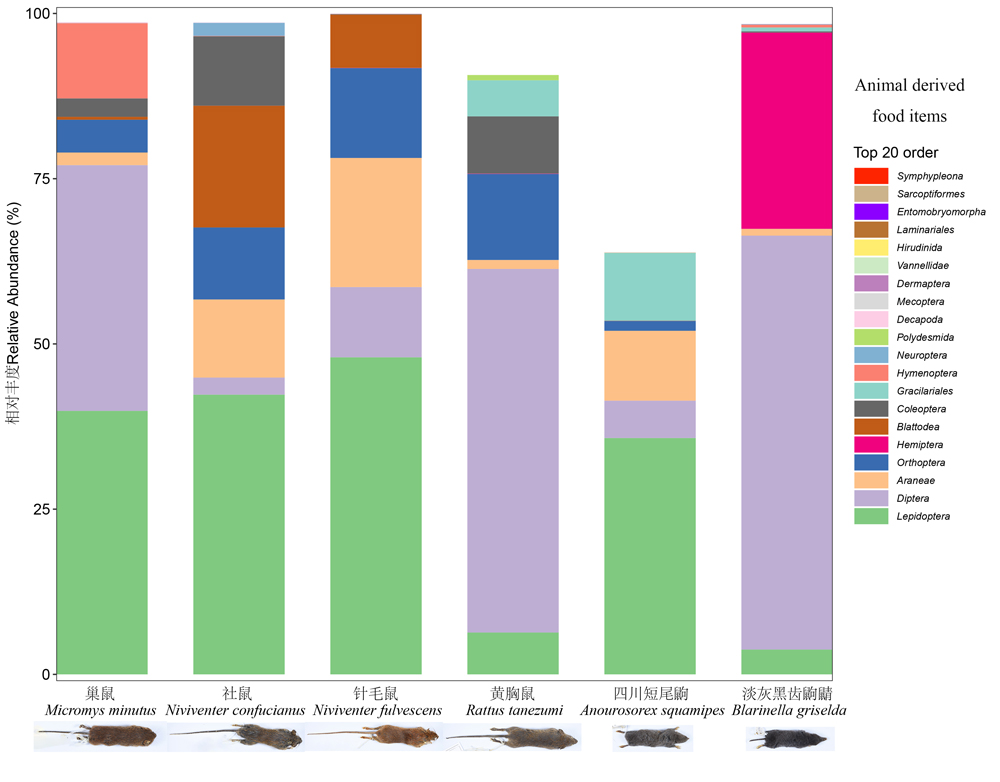
揭示物种共存的发生和维持机制对于群落生态学理论的发展具有重要意义, 同时也是生物多样性和保护生物学研究的热点之一。生态位分化是同域分布物种实现共存的重要原因之一。为了解同域分布的多种小型哺乳动物的共存机制, 本研究采用DNA宏条形码技术对四川老君山国家级自然保护区内的6种小型哺乳动物胃内容物进行分子食性分析, 解析其夏季食物组成特征, 并计算和比较种间食物的多样性、生态位宽度和重叠指数。结果表明: (1)鳞翅目(相对丰度: 3.76%-42.33%)和双翅目(2.59%-62.63%)是6种小型哺乳动物的主要动物性食物, 禾本目(0.02%-45.33%)和豆目(0.19%-38.95%)为其主要植物性食物。6种小型哺乳动物取食主要动植物性食物的相对丰度存在种间差异。(2)黄胸鼠(Rattus tanezumi)和淡灰黑齿鼩鼱(Blarinella griselda)的属水平动物性食物显著重叠(Ojk = 0.63); 其余物种间的营养生态位存在一定程度重叠, 但在主要食物的构成和组成比例上存在明显差异; (3) 6种小型哺乳动物的动物性食物α多样性存在明显种间差异, 而植物性食物α多样性在6种小型哺乳动物之间差异不显著, 其中社鼠(Niviventer confucianus)食物多样性最高, 其动植物营养生态位宽度(8.2-11.1)均高于其余物种。以上结果表明6种小型哺乳动物的食物组成存在一定程度重叠, 但在主要食物上出现分离, 它们可能通过对主要食物摄食种类和比例的分化来减少竞争, 实现长期共存。本研究为揭示四川老君山地区多种小型哺乳动物物种多样性的维持机制提供理论依据, 也为该地区鼠形动物的生态管理提供参考。考虑到本研究在样本量和时间尺度上的局限性, 未来基于营养生态位对多种小型哺乳动物进行同域共存机制研究时建议适当增加取样的时空跨度, 更多的样本量能更好地反映种间关系。
本文引用格式
彭步青 , 陶玲 , 李靖 , 范荣辉 , 陈顺德 , 付长坤 , 王琼 , 唐刻意 . 基于DNA宏条形码研究四川老君山国家级自然保护区6种同域共存小型哺乳动物的食性[J]. 生物多样性, 2023 , 31(4) : 22474 . DOI: 10.17520/biods.2022474
Abstract
Aim: Revealing the mechanisms that determine species coexistence is of great importance for the development of community ecology theoretical concepts/ which is one of the hot spot for biodiversity and conservation biology research. Niche separation is an important reason for the coexistence of sympatric species.
Methods: To determine the dietary composition of six sympatric small mammals at the Laojunshan Nature Reserve, Sichuan, the animal samples were trapped and the luminal stomach contents were collected. We used two DNA metabarcoding assays (chloroplast RbcL and mitochondrial COI region sequences) to better understand their dietary diversity, niche breadth and overlap.
Results: (1) Lepidoptera (relative abundance: 3.76%-42.33%) and Diptera (2.59%-62.63%) were the prey items identified, while Poales (0.02%-45.33%) and Fabales (0.19%-38.95%) were the taxa that constituted the majority of plant-derived foods. In addition to this, inter-specific differences in relative abundance of these main food items were observed. (2) We found that there was a significant trophic overlap (Ojk = 0.63) of animal derived diet between Rattus tanezumi and Blarinella griselda. A certain degree of food niche overlap was found between the other sampled species, yet there were still significant differences in the composition and proportion of predominant food items. (3) A certain inter-specific difference in α diversity of animal derived food between the six small mammals was detected, while almost no differences in α diversity of plant derived foods were found between the six small mammals. Niviventer confucianus had the highest dietary diversity, with higher niches breadth (8.2-11.1) of both plant- and animal-derived diets than those of the other five species.
Conclusion: These results suggest that, although the dietary overlap is observed in six small mammals, they can reduce foods competition and achieve long-term coexistence through separating the types and proportions of the main food items. Furthermore, this study reveals the mechanism of maintaining the diversity of various small mammal species at the Laojunshan Nature Reserve. This study also contributes to the ecological management of rodent-like animals in this area. Considering the limitations of our sample size and time scale of sampling, we believe that increasing sample size and time span can be more effective at identifying inter-specific relationship through DNA metabarcoding.
参考文献
| [1] | Akrim F, Mahmood T, Max T, Nadeem MS, Qasim S, Andleeb S (2018) Assessment of bias in morphological identification of carnivore scats confirmed with molecular scatology in north-eastern Himalayan region of Pakistan. PeerJ, 6, e5262. |
| [2] | Berry TE, Osterrieder SK, Murray DC, Coghlan ML, Richardson AJ, Grealy AK, Stat M, Bejder L, Bunce M (2017) DNA metabarcoding for diet analysis and biodiversity: A case study using the endangered Australian sea lion (Neophoca cinerea). Ecology and Evolution, 7, 5435-5453. |
| [3] | Biffi M, Laffaille P, Jabiol J, André A, Gillet F, Lamothe S, Michaux JR, Buisson L (2017) Comparison of diet and prey selectivity of the Pyrenean desman and the Eurasian water shrew using next-generation sequencing methods. Mammalian Biology, 87, 176-184. |
| [4] | Burgar JM, Murray DC, Craig MD, Haile J, Houston J, Stokes V, Bunce M (2014) Who’s for dinner? High-throughput sequencing reveals bat dietary differentiation in a biodiversity hotspot where prey taxonomy is largely undescribed. Molecular Ecology, 23, 3605-3617. |
| [5] | Calhoun JB (1941) Distribution and food habits of mammals in the vicinity of the Reelfoot Lake Biological Station. Journal of the Tennessee Academy of Science, 16, 177-185. |
| [6] | Caporaso JG, Lauber CL, Walters WA, Berg-Lyons D, Huntley J, Fierer N, Owens SM, Betley J, Fraser L, Bauer M, Gormley N, Gilbert JA, Smith G, Knight R (2012) Ultra-high-throughput microbial community analysis on the Illumina HiSeq and MiSeq platforms. The ISME Journal, 6, 1621-1624. |
| [7] | Chen WW, Zhong J, Liu SX, Xiong GM, Chen FQ, Xie ZQ, Jiang GH, Zhou YB (2014) Variations in food habit and viscera organ morphology of four rodents in Shennongjia, central China. Acta Ecologica Sinica, 34, 3620-3628. (in Chinese with English abstract) |
| [7] | [ 陈文文, 钟杰, 刘三峡, 熊高明, 陈芳清, 谢宗强, 江广华, 周友兵 (2014) 神农架地区4种啮齿类食性及脏器形态差异比较. 生态学报, 34, 3620-3628.] |
| [8] | Churchfield JS (1979) A note on the diet of the European Water shrew, Neomys fodiens bicolor. Journal of Zoology, 188, 294-296. |
| [9] | Churchfield S, Rychlik L (2006) Diets and coexistence in Neomys and Sorex shrews in Bia?owie?a forest, eastern Poland. Journal of Zoology, 269, 381-390. |
| [10] | Churchfield S, Sheftel BI (1994) Food niche overlap and ecological separation in a multi-species community of shrews in the Siberian taiga. Journal of Zoology, 234, 105-124. |
| [11] | Clare EL, Symondson WOC, Broders H, Fabianek F, Fraser EE, MacKenzie A, Boughen A, Hamilton R, Willis CKR, Martinez-Nu?ez F, Menzies AK, Norquay KJO, Brigham M, Poissant J, Rintoul J, Barclay RMR, Reimer JP (2014) The diet of Myotis lucifugus across Canada: Assessing foraging quality and diet variability. Molecular Ecology, 23, 3816-3832. |
| [12] | Cooke SB, Crowley BE (2018) Deciphering the isotopic niches of now-extinct Hispaniolan rodents. Journal of Vertebrate Paleontology, 38, e1510414. |
| [13] | Crozier WW (1985) Observations on the food and feeding of the angler-fish, Lophim piscatorius L., in the northern Irish Sea. Journal of Fish Biology, 27, 655-665. |
| [14] | De León LF, Podos J, Gardezi T, Herrel A, Hendry AP (2014) Darwin’s finches and their diet niches: The sympatric coexistence of imperfect generalists. Journal of Evolutionary Biology, 27, 1093-1104. |
| [15] | Deagle BE, Thomas AC, McInnes JC, Clarke LJ, Vesterinen EJ, Clare EL, Kartzinel TR, Eveson JP (2019) Counting with DNA in metabarcoding studies: How should we convert sequence reads to dietary data? Molecular Ecology, 28, 391-406. |
| [16] | Deng Z (1991) Harm of rodents to human health. Chinese Journal of Public Health, 7, 131-134. (in Chinese) |
| [16] | [ 邓址 (1991) 啮齿动物对人类健康的危害. 中国公共卫生, 7, 131-134.] |
| [17] | Edgar RC (2013) UPARSE: Highly accurate OTU sequences from microbial amplicon reads. Nature Methods, 10, 996-998. |
| [18] | Fu YQ, Wen LY, Dai B, Chen BP, Zhang ZW (2016) Winter habitat characteristics of Sichuan partridge (Arborophila rufipectus). Chinese Journal of Ecology, 35, 3012-3016. (in Chinese with English abstract) |
| [18] | [ 付义强, 文陇英, 戴波, 陈本平, 张正旺 (2016) 四川山鹧鸪冬季栖息地特征. 生态学杂志, 35, 3012-3016.] |
| [19] | Grinnell J (1917) The niche-relationships of the California thrasher. The Auk, 34, 427-433. |
| [20] | Guo YP, Zhang H, Zhao XG, Luo HL, Zhang YJ (2021) Applications of DNA metabarcoding in diet identification of herbivores. Biotechnology Bulletin, 37, 252-260. (in Chinese with English abstract) |
| [20] | [ 郭艳萍, 张浩, 赵新钢, 罗海玲, 张英俊 (2021) DNA宏条形码技术在食草动物食性研究中的应用. 生物技术通报, 37, 252-260.] |
| [21] | Hardin G (1960) The competitive exclusion principle. Science, 131, 1292-1297. |
| [22] | He K, Li Y, Brandley MC, Lin L, Wang Y, Zhang Y, Jiang X (2010) A multi-locus phylogeny of Nectogalini shrews and influences of the paleoclimate on speciation and evolution. Molecular Phylogenetics and Evolution, 56, 734-746. |
| [23] | Hoffman J, Sylvester T, Lyons E (2012) Diet and ectoparasites of the southern short-tailed shrew (Blarina carolinensis) in Louisiana. Western North American Naturalist, 72, 586-590. |
| [24] | Hofreiter M, Poinar HN, Spaulding WG, Bauer K, Martin PS, Possnert G, P??bo S (2000) A molecular analysis of ground sloth diet through the last glaciation. Molecular Ecology, 9, 1975-1984. |
| [25] | Hou JJ, Li L, Wang YF, Wang WJ, Zhan HY, Dai NH, Lu P (2021) Influences of submerged plant collapse on diet composition, breadth, and overlap among four crane species at Poyang Lake, China. Frontiers in Zoology, 18, 1-17. |
| [26] | Huisman J, Weissing FJ (1999) Biodiversity of plankton by species oscillations and chaos. Nature, 402, 407-410. |
| [27] | Jow J, Hartman GD, Hein R (1994) Food and ectoparasites of the southern short-tailed shrew, Blarina carolinensis (Mammalia: Soricidae), from South Carolina. Brimleyana, 21, 97-105. |
| [28] | Jusino MA, Banik MT, Palmer JM, Wray AK, Xiao L, Pelton E, Barber JR, Kawahara AY, Gratton C, Peery MZ, Lindner DL (2019) An improved method for utilizing high-throughput amplicon sequencing to determine the diets of insectivorous animals. Molecular Ecology Resources, 19, 176-190. |
| [29] | Kartzinel TR, Chen PA, Coverdale TC, Erickson DL, Kress WJ, Kuzmina ML, Rubenstein DI, Wang W, Pringle RM (2015) DNA metabarcoding illuminates dietary niche partitioning by African large herbivores. Proceedings of the National Academy of Sciences, USA, 112, 8019-8024. |
| [30] | Krebs CJ (1999) Ecological Methodology. Addison Wesley Longman, Menlo Park. |
| [31] | Krüger F, Clare EL, Greif S, Siemers BM, Symondson WC, Sommer RS (2014) An integrative approach to detect subtle trophic niche differentiation in the sympatric trawling bat species Myotis dasycneme and Myotis daubentonii. Molecular Ecology, 23, 3657-3671. |
| [32] | Ladine T, Munoz A (2010) Food habits of the southern short-tailed shrew (Blarina carolinensis) in East Texas. Texas Journal of Science, 62, 153-156. |
| [33] | Levins R (1968) Evolution in Changing Environment. Princeton University Press, Princeton. |
| [34] | Li TB (2020) Analysis of feeding habits of forest rodents in Wangwu Mountain area of Jiyuan City. Modern Agricultural Science and Technology, (20), 83-85, 88. (in Chinese with English abstract) |
| [34] | [ 李天保 (2020) 济源市王屋山地区林栖鼠类食性分析. 现代农业科技, (20), 83-85, 88.] |
| [35] | Li XM, Li SJ, He JF (1989) Preliminary observation on feeding habits and activities of Rattus norvegicus and Rattus flavipectus. Chinese Journal of Vector Biology and Control, (4), 209. (in Chinese) |
| [35] | [ 李新民, 李书建, 贺金方 (1989) 对褐家鼠、黄胸鼠食性及活动规律的初步观察. 中国鼠类防制杂志, (4), 209.] |
| [36] | Liao WB, Fuller RA, Hu JC, Li C (2008) Habitat use by endangered Sichuan partridges Arborophila rufipectus during the breeding season. Acta Ornithologica, 43, 179-184. |
| [37] | Liao WB, Li C, Hu JC, Lu X (2007) Habitat utilization of the Sichuan hill partridge (Arborophila rufipectus) in the non-breeding period in Laojunshan Nature Reserve. Zoological Research, 28, 172-178. |
| [38] | Liu G, Ning Y, Xia XF, Gong MH (2018) The application of high-throughput sequencing technologies to wildlife diet analysis. Acta Ecologica Sinica, 38, 3347-3356. (in Chinese with English abstract) |
| [38] | [ 刘刚, 宁宇, 夏晓飞, 龚明昊 (2018) 高通量测序技术在野生动物食性分析中的应用. 生态学报, 38, 3347-3356.] |
| [39] | Liu ZS, Wang XM, Teng LW, Cao LR (2007) Food habits of blue sheep, Pseudois nayaur in the Helan Mountains, China. Folia Zoologica, 56, 13-22. |
| [40] | Lu Q, Hu Q, Shi XG, Jin SL, Li S, Yao M (2019) Metabarcoding diet analysis of snow leopards (Panthera uncia) in Wolong National Nature Reserve, Sichuan Province. Biodiversity Science, 27, 960-969. (in Chinese with English abstract) |
| [40] | [ 陆琪, 胡强, 施小刚, 金森龙, 李晟, 姚蒙 (2019) 基于分子宏条形码分析四川卧龙国家级自然保护区雪豹的食性. 生物多样性, 27, 960-969.] |
| [41] | MacArthur RH, Pianka ER (1966) On optimal use of a patchy environment. The American Naturalist, 100, 603-609. |
| [42] | Marshal JP, Bleich VC, Andrew NG, Bighorn S, Andrew N (2008) Evidence for interspecific competition between feral ass Equus asinus and mountain sheep Ovis canadensis in a desert environment. Wildlife Biology, 14, 228-236. |
| [43] | Pianka ER (1973) The structure of lizard communities. Annual Review of Ecology and Systematics, 4, 53-74. |
| [44] | Pompanon F, Deagle BE, Symondson WOC, Brown DS, Jarman SN, Taberlet P (2012) Who is eating what: Diet assessment using next generation sequencing. Molecular Ecology, 21, 1931-1950. |
| [45] | Porter LM (2001) Dietary differences among sympatric Callitrichinae in northern Bolivia: Callimico goeldii, Saguinus fuscicollis and S. labiatus. International Journal of Primatology, 22, 961-992. |
| [46] | Razgour O, Clare EL, Zeale MRK, Hanmer J, Schnell IB, Rasmussen M, Gilbert TP, Jones G (2011) High-throughput sequencing offers insight into mechanisms of resource partitioning in cryptic bat species. Ecology and Evolution, 1, 556-570. |
| [47] | Rognes T, Flouri T, Nichols B, Quince C, Mahé F (2016) Vsearch: A versatile open source tool for metagenomics. PeerJ, 4, e2584. |
| [48] | Rutrough A, Widick IV, Bean WT (2019) Reconstruction of the historical range alters niche estimates in an endangered rodent. Ecography, 42, 1742-1751. |
| [49] | Shao XN, Lu Q, Xiong MY, Bu HL, Shi XY, Wang DJ, Zhao JD, Li S, Yao M (2021) Prey partitioning and livestock consumption in the world’s richest large carnivore assemblage. Current Biology, 31, 4887-4897. |
| [50] | Shao XN, Song DZ, Huang QW, Li S, Yao M (2019) Fast surveys and molecular diet analysis of carnivores based on fecal DNA and metabarcoding. Biodiversity Science, 27, 543-556. (in Chinese with English abstract) |
| [50] | [ 邵昕宁, 宋大昭, 黄巧雯, 李晟, 姚蒙 (2019) 基于粪便DNA及宏条形码技术的食肉动物快速调查及食性分析. 生物多样性, 27, 543-556.] |
| [51] | Shutt JD, Nicholls JA, Trivedi UH, Burgess MD, Stone GN, Hadfield JD, Phillimore AB (2020) Gradients in richness and turnover of a forest passerine’s diet prior to breeding: A mixed model approach applied to faecal metabarcoding data. Molecular Ecology, 29, 1199-1213. |
| [52] | Sommer U (1999) Competition and coexistence. Nature, 402, 366-367. |
| [53] | Sullins DS, Haukos DA, Craine JM, Lautenbach JM, Robinson SG, Lautenbach JD, Kraft JD, Plumb RT, Reitz JH, Sandercock BK, Fierer N (2018) Identifying the diet of a declining prairie grouse using DNA metabarcoding. The Auk, 135, 583-608. |
| [54] | Taberlet P, Coissac E, Pompanon F, Brochmann C, Willerslev E (2012) Towards next-generation biodiversity assessment using DNA metabarcoding. Molecular Ecology, 21, 2045-2050. |
| [55] | Tang KY, Xie F, Liu HY, Pu YT, Chen D, Qin BX, Fu CK, Wang Q, Chen SD, Guo KJ (2021) DNA metabarcoding provides insights into seasonal diet variations in Chinese mole shrew (Anourosorex squamipes) with potential implications for evaluating crop impacts. Ecology and Evolution, 11, 376-389. |
| [56] | Udvardy MFD (1959) Notes on the ecological concepts of habitat, biotope and niche. Ecology, 40, 725-788. |
| [57] | Wang C, Su HJ, Hu CS, Shi L, Zhang MM (2020) Spatial distribution of sympatric Rhinopithecus brelichi and Macaca thibetana in Fanjingshan National Nature Reserve, Guizhou, China. Acta Theriologica Sinica, 40, 193-200. (in Chinese with English abstract) |
| [57] | [ 王丞, 粟海军, 胡灿实, 石磊, 张明明 (2020) 梵净山保护区同域分布黔金丝猴与藏酋猴的空间分布初探. 兽类学报, 40, 193-200.] |
| [58] | Wang DL, Li XC, Pan DF, De KJ (2016) The ecological significance and controlling of rodent outbreaks in the Qinghai-Tibetan Grasslands. Journal of Southwest University for Nationalities (Natural Science Edition), 42, 237-245. (in Chinese with English abstract) |
| [58] | [ 王德利, 李心诚, 潘多峰, 德科加 (2016) 青藏高原草地鼠害的生态释义及控制. 西南民族大学学报(自然科学版), 42, 237-245.] |
| [59] | Wang GL (2004) Causes and control countermeasures of forest rodent damage in Bailongjiang forest area. Journal of Gansu Forestry Science and Technology, 29(4), 74-75. (in Chinese with English abstract) |
| [59] | [ 王贵来 (2004) 白龙江林区森林鼠害发生原因及防治对策. 甘肃林业科技, 29(4), 74-75.] |
| [60] | Wang GM, Zhou QQ, Zhong WQ (1996) Trophic niches of four species of common small mammals in Inner Mongolia grassland and their relationships. Acta Ecologica Sinica, 16, 71-76. (in Chinese with English abstract) |
| [60] | [ 王桂明, 周庆强, 钟文勤 (1996) 内蒙古典型草原4种常见小哺乳动物的营养生态位及相互关系. 生态学报, 16, 71-76.] |
| [61] | Wang MC, Han CX, Hu ZL, Chen XD, Yang XJ (1997) A study on Gansu Zokor’s feeding rhythm and its food preference to different beits. Acta Universitatis Agriculturae Boreali-Occidentalis, 25(2), 46-50. (in Chinese with English abstract) |
| [61] | [ 王明春, 韩崇选, 胡忠朗, 陈孝达, 杨学军 (1997) 甘肃鼢鼠取食节律及对不同饵料喜食性的研究. 西北农业大学学报, 25(2), 46-50.] |
| [62] | Wang XQ, Wang GH, Qiao F, Gao QK, Heong KL, Zhu ZR, Cheng JA (2017) Progress on high-throughput sequencing and its applications in food web analysis. Acta Ecologica Sinica, 37, 2530-2539. (in Chinese with English abstract) |
| [62] | [ 王雪芹, 王光华, 乔飞, 高其康, Heong KL, 祝增荣, 程家安 (2017) 高通量测序及其在食物网解析中的应用进展. 生态学报, 37, 2530-2539.] |
| [63] | Whitaker J (2006) Food of the southern short-tailed shrew (Blarina carolinensis) on Cumberland Island, Georgia. Southeastern Naturalist, 5, 361-366. |
| [64] | Wickham H (2009) ggplot2:Elegant Graphics for Data Analysis. Springer-Verlag, New York. |
| [65] | Xi LYZ, Luo G, Ran JH, Feng SL, Chen JW, Chen BP (2020) Habitat use and change of Arborophila rufiperctus during the breeding season in the Laojunshan National Nature Reserve, Sichuan. Sichuan Journal of Zoology, 39, 258-265. (in Chinese with English abstract) |
| [65] | [ 西丽媛子, 罗概, 冉江洪, 冯盛林, 陈建武, 陈本平 (2020) 四川老君山国家级自然保护区四川山鹧鸪繁殖期的生境利用及其变化研究. 四川动物, 39, 258-265.] |
| [66] | Yang CW, Ma JZ, Jin JL, Liu Z (2008) Research on autumn time niche of five rodents in forests ecosystem. Chinese Journal of Zoology, 43(2), 64-69. (in Chinese with English abstract) |
| [66] | [ 杨春文, 马建章, 金建丽, 刘铸 (2008) 森林生态系统中5种啮齿动物秋季时间生态位. 动物学杂志, 43(2), 64-69.] |
| [67] | Yang YZ, Zhan AB, Cao L, Meng FJ, Xu WB (2016) Selection of a marker gene to construct a reference library for wetland plants, and the application of metabarcoding to analyze the diet of wintering herbivorous waterbirds. PeerJ, 4, e2345. |
| [68] | Yin BF, Huai HY, Zhang YL, Zhou L, Wei WH (2007) Trophic niches of Pantholops hodgsoni, Procapra picticaudata and Equus kiang in Kekexili Region. Chinese Journal of Applied Ecology, 18, 766-770. (in Chinese with English abstract) |
| [68] | [ 殷宝法, 淮虎银, 张镱锂, 周乐, 魏万红 (2007) 可可西里地区藏羚羊、藏原羚和藏野驴的营养生态位. 应用生态学报, 18, 766-770.] |
| [69] | Yong ZY, Guo C, Zhang MW, Wang Y, Li B (2011) Significance and methodology of rodent’s food habit research: A review. Chinese Journal of Ecology, 30, 2637-2645. (in Chinese with English abstract) |
| [69] | [ 雍仲禹, 郭聪, 张美文, 王勇, 李波 (2011) 啮齿动物食性研究的意义及方法评述. 生态学杂志, 30, 2637-2645.] |
| [70] | Zhang CJ, Wang XY, Yao BH, Wang C, Kang YK, Zhang Q, Su JH (2021) Diet composition and trophic niche characteristics of three rodents in Gannan meadow. Acta Agrestia Sinica, 29, 1484-1490. (in Chinese with English abstract) |
| [70] | [ 张彩军, 王小燕, 姚宝辉, 王缠, 康宇坤, 张倩, 苏军虎 (2021) 甘南草原3种啮齿动物的食性及其营养生态位特征. 草地学报, 29, 1484-1490.] |
| [71] | Zhang YY, Dong JY, Sun X, Zhang XM (2022) Bibliometric analysis of food habit research based on DNA molecular biology. Fisheries Science, 41, 160-172. (in Chinese with English abstract) |
| [71] | [ 张宇洋, 董建宇, 孙昕, 张秀梅 (2022) 基于DNA分子生物学食性研究领域的文献计量分析. 水产科学, 41, 160-172.] |
| [72] | Zhao G (2021) A review of rodent feeding methods. Biological Chemical Engineering, 7(5), 163-165. (in Chinese with English abstract) |
| [72] | [ 赵耕 (2021) 啮齿动物食性研究方法. 生物化工, 7(5), 163-165.] |
| [73] | Zhong LQ (2020) Feeding and Nutrition Strategy and Feeding Habitat Evaluation of Red Deer and Sika Deer Distributed in the Same Domain. PhD dissertation, Northeast Forestry University, Harbin. (in Chinese with English abstract) |
| [73] | [ 钟林强 (2020) 同域分布马鹿与梅花鹿采食和营养策略及采食生境评价. 博士学位论文, 东北林业大学, 哈尔滨.] |