极端干旱区荒漠灌木叶际细菌群落多样性特征
Diversity characteristics of phyllosphere bacterial communities in desert shrubs in hyper-arid regions
极端干旱区荒漠灌木叶际细菌群落多样性特征 |
| 尹翔正, 姜海燕, 张俊, 罗春生, 张元明 |
|
Diversity characteristics of phyllosphere bacterial communities in desert shrubs in hyper-arid regions |
| Xiangzheng Yin, Haiyan Jiang, Jun Zhang, Chunsheng Luo, Yuanming Zhang |
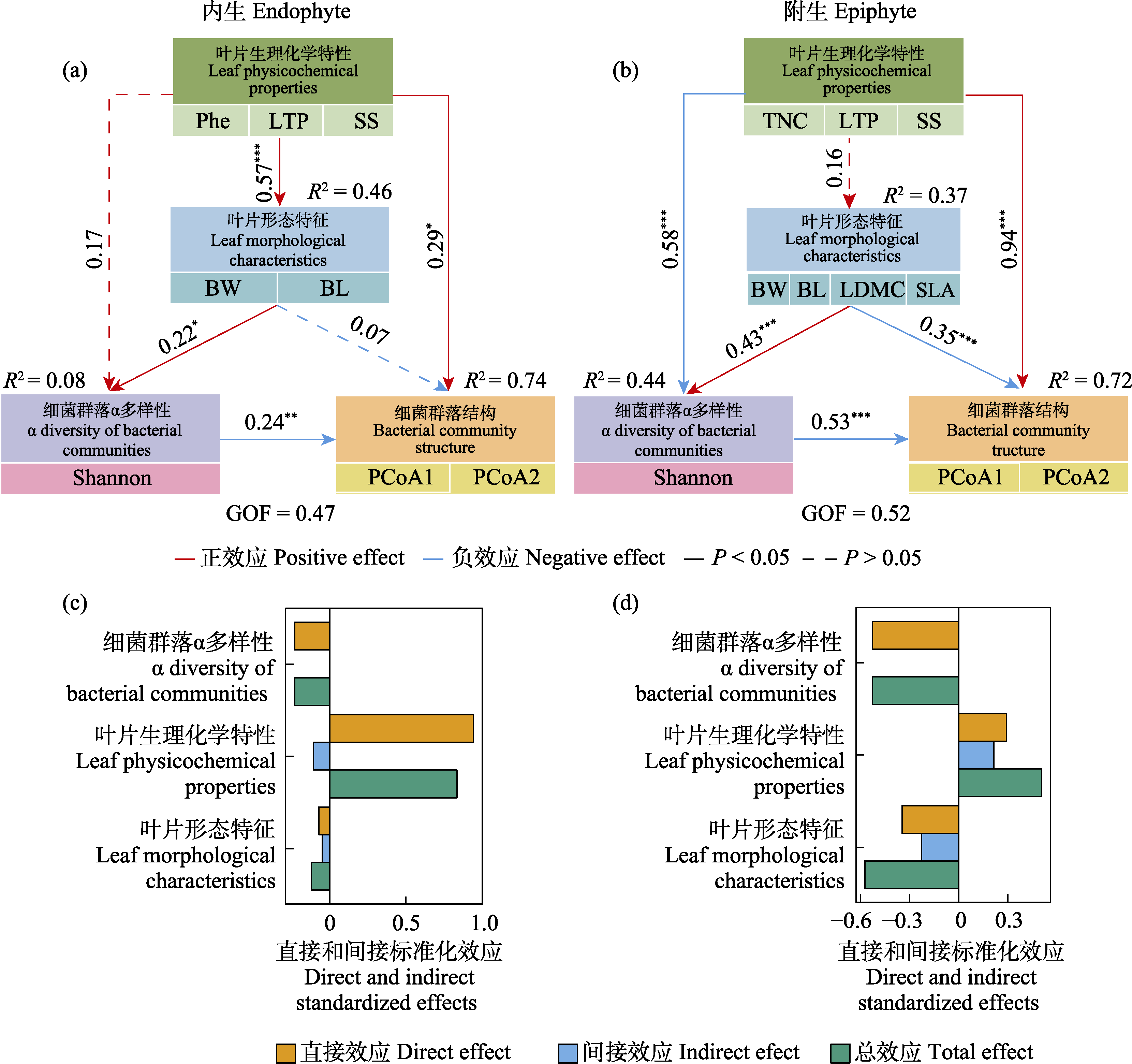
| 图4 荒漠灌木叶际细菌群落结构变异的主要影响因素。(a)叶际内生细菌群落结构方程模型; (b)叶际附生细菌群落结构方程模型; 箭头旁数值为标准化路径系数, 实线表示显著效应(P<0.05), 虚线表示不显著效应(P>0.05), 红色和蓝色分别表示正效应和负效应, R2为变量解释度, GOF为模型拟合优度。(c)各变量对叶际内生细菌群落结构的标准化效应分解; (d)各变量对叶际附生细菌群落结构的标准化效应分解。*P<0.05; **P<0.01; ***P<0.001。叶片功能性状对应缩写见 |
| Fig. 4 The key factors influencing the variation of phyllosphere bacterial community structure in desert shrubs. (a) Structural equation model of phyllosphere endophytic bacterial communities; (b) Structural equation model of phyllosphere epiphytic bacterial communities. Values next to arrows are standardized path coefficients. Solid lines indicate significant effects (P < 0.05), while dashed lines indicate non-significant effects (P > 0.05). Red and blue lines represent positive and negative effects, respectively. R2 denotes the explained variance of variables, and GOF denotes the goodness of model fit. (c) Decomposition of standardized effects of each variable on the structure of phyllosphere endophytic bacterial communities; (d) Decomposition of standardized effects of each variable on the structure of phyllosphere epiphytic bacterial communities. * P < 0.05; ** P < 0.01; *** P < 0.001. The corresponding abbreviations of leaf functional traits are shown in |
|
|