生物多样性评估挑战的层级占有率模型解决路径
Hierarchical occupancy models as solutions to challenges in biodiversity assessment
生物多样性评估挑战的层级占有率模型解决路径 |
| 吴春莹, Viorel D. Popescu, 季吟秋 |
|
Hierarchical occupancy models as solutions to challenges in biodiversity assessment |
| Chunying Wu, Viorel D. Popescu, Yinqiu Ji |
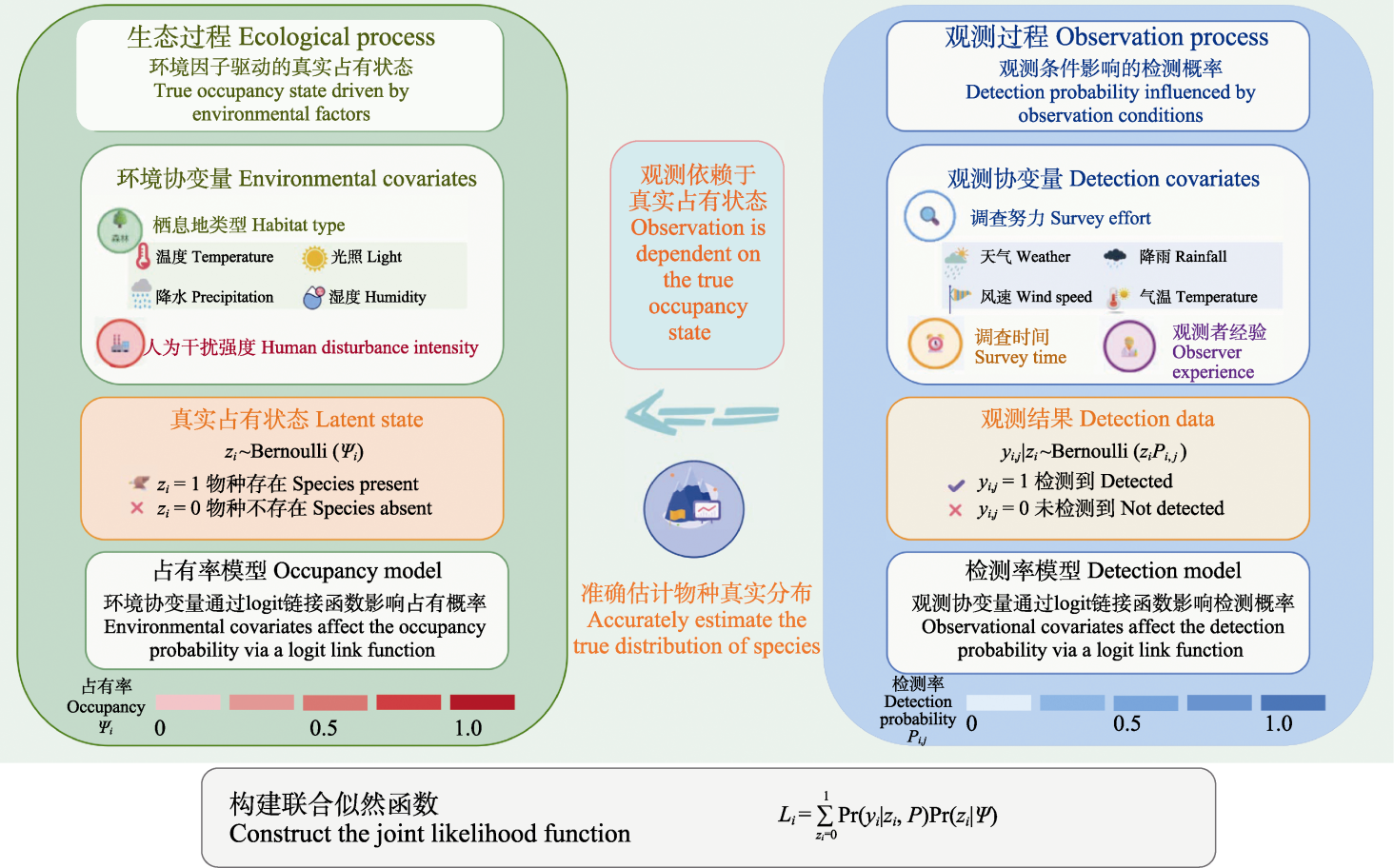
| 图3 层级占有率模型的双层统计框架。该示意图展示了层级占有率模型的双层统计逻辑, 其核心在于通过对生态过程与观测过程的解耦, 有效校正物种调查中的不完全检测问题。左侧生态过程描述由环境因子驱动的真实占有状态(即潜变量zi); 在此层级中, 样点的占有概率ψ受栖息地类型(如森林覆盖率、植被结构)、非生物因子及人为干扰等环境协变量的影响, 并采用logit链接函数进行建模。右侧观测过程则描述实际调查中的检测概率P, 该概率受调查努力(如调查时长、采样强度、重复次数)、天气条件及观测者经验等观测协变量的影响, 同样通过logit链接函数建立联系。由于观测结果y严格依赖于真实占有状态z (即仅在物种真实存在的条件下, 检测概率才具有生物学意义), 模型通过对zi进行边缘化处理并构建联合似然函数。这一机制通过数学手段消除了假缺失(false absences)导致的估计偏差, 从而实现对物种真实分布的无偏估计。 |
| Fig. 3 Dual-level statistical framework of the hierarchical occupancy model. This figure illustrates the dual-level statistical framework of the hierarchical occupancy model, which centers on correcting for imperfect detection in species surveys by decoupling the ecological and observation processes. The ecological process on the left describes the true occupancy state (latent variable zi) driven by environmental factors; the occupancy probability ψ is influenced by environmental covariates—such as habitat type (e.g., forest cover, vegetation structure), abiotic factors, and human disturbance—and is modeled via a logit link function. The observation process on the right describes the detection probability P during field surveys, which is affected by observational covariates including survey effort (duration, intensity, and number of replicates), weather conditions, and observer experience, also linked through a logit function. Given that the observation y is strictly dependent on the true occupancy state z (meaning a species can only be detected if it is truly present), the model integrates these processes by marginalizing over the latent variable zi to construct a joint likelihood function. This approach mathematically accounts for false absences, thereby achieving an unbiased estimation of the true species distribution. |
|
|