联合物种分布模型与生物群落层次建模框架: 生态学理论、方法及应用
Theoretical foundations, methodological advances, and applications of joint species distribution models with a focus on the HMSC framework in ecology
联合物种分布模型与生物群落层次建模框架: 生态学理论、方法及应用 |
| 谷际岐, 赖江山, 王瑛, 吴浩然, 张雪, 宋晓彤, 邵小明, 娄安如 |
|
Theoretical foundations, methodological advances, and applications of joint species distribution models with a focus on the HMSC framework in ecology |
| Jiqi Gu, Jiangshan Lai, Ying Wang, Haoran Wu, Xue Zhang, Xiaotong Song, Xiaoming Shao, Anru Lou |
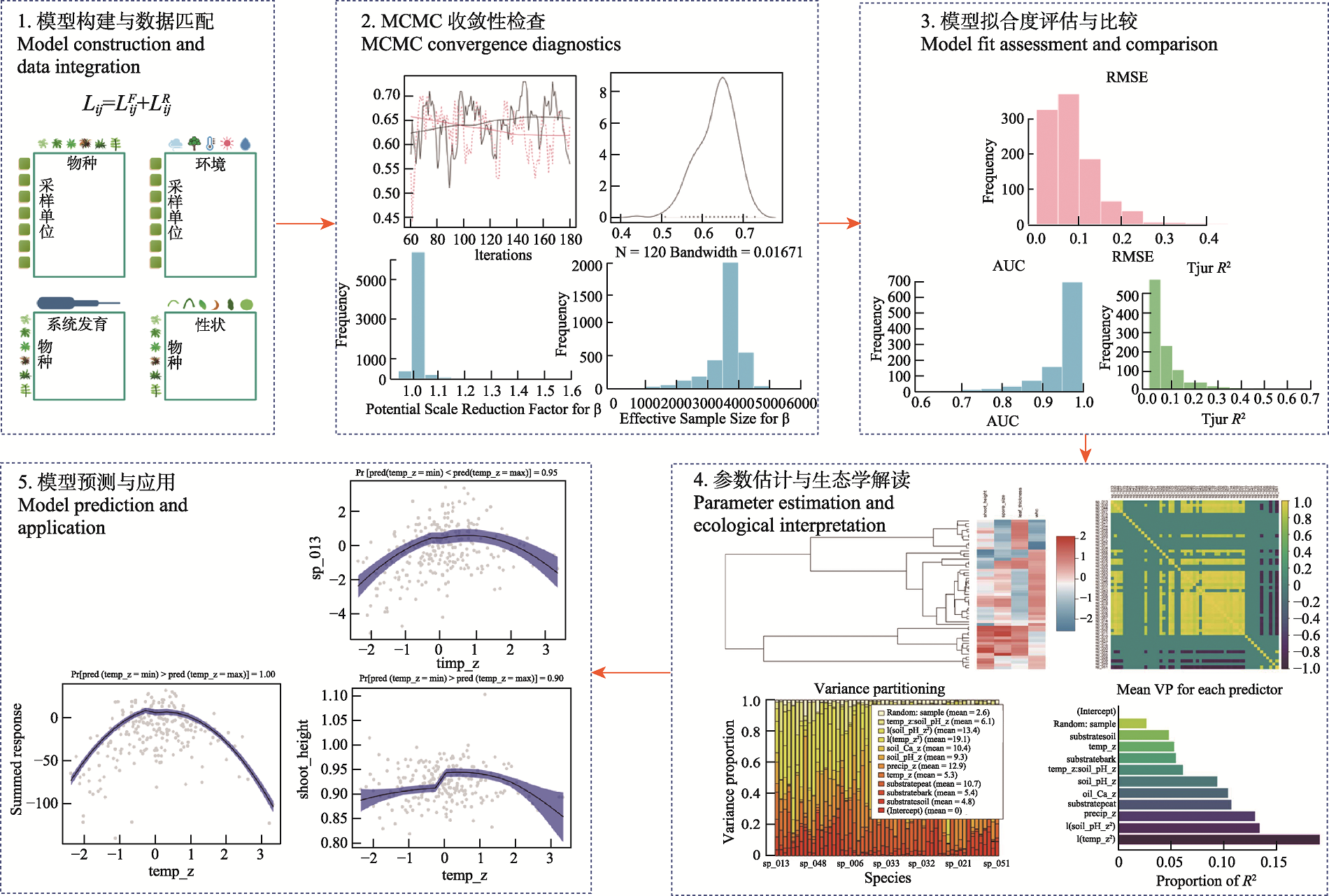
| 图2 生物群落层次建模(HMSC)框架的完整分析流程与结果示意。图中依次展示了HMSC建模与推断的5个关键步骤: (1)模型构建与数据匹配, 将物种分布数据与环境因子、功能性状、系统发育和空间随机效应整合到统一的层级贝叶斯框架中; (2) MCMC收敛性检查, 通过迹线图、后验分布、有效样本量和潜在尺度缩减因子评估模型收敛与参数混合情况; (3)模型拟合度评估与比较, 利用均方根误差(RMSE)、曲线下面积(AUC)和R2等指标量化模型预测性能; (4)参数估计与生态解释, 包括环境响应参数、性状与系统发育效应、残差相关结构以及方差分解结果; (5)模型预测与应用, 展示物种对关键环境梯度的响应曲线及不确定性区间, 用于群落分布预测与情景分析。 |
| Fig. 2 Schematic overview of the complete analytical workflow and outputs of hierarchical modelling of species communities (HMSC) framework. The figure illustrates five key steps of HMSC-based modelling and inference: (1) model construction and data integration, in which species distribution data are jointly modelled with environmental variables, functional traits, phylogenetic relationships, and spatial random effects within a unified hierarchical Bayesian framework; (2) MCMC convergence diagnostics, where trace plots, posterior distributions, effective sample size (ESS), and potential scale reduction factors (PSRF) are used to assess convergence and fitness parameter mixing; (3) model fit evaluation and comparison, in which predictive performance is quantified using root mean square error (RMSE), area under curve (AUC), and R²; (4) parameter estimation and ecological interpretation, including environmental response parameters, trait and phylogenetic effects, residual correlation structures, and variance partitioning; and (5) model prediction and application, illustrating species responses to key environmental gradients with associated uncertainty intervals for community-level prediction and scenario-based analyses. |
|
|