联合物种分布模型与生物群落层次建模框架: 生态学理论、方法及应用
Theoretical foundations, methodological advances, and applications of joint species distribution models with a focus on the HMSC framework in ecology
联合物种分布模型与生物群落层次建模框架: 生态学理论、方法及应用 |
| 谷际岐, 赖江山, 王瑛, 吴浩然, 张雪, 宋晓彤, 邵小明, 娄安如 |
|
Theoretical foundations, methodological advances, and applications of joint species distribution models with a focus on the HMSC framework in ecology |
| Jiqi Gu, Jiangshan Lai, Ying Wang, Haoran Wu, Xue Zhang, Xiaotong Song, Xiaoming Shao, Anru Lou |
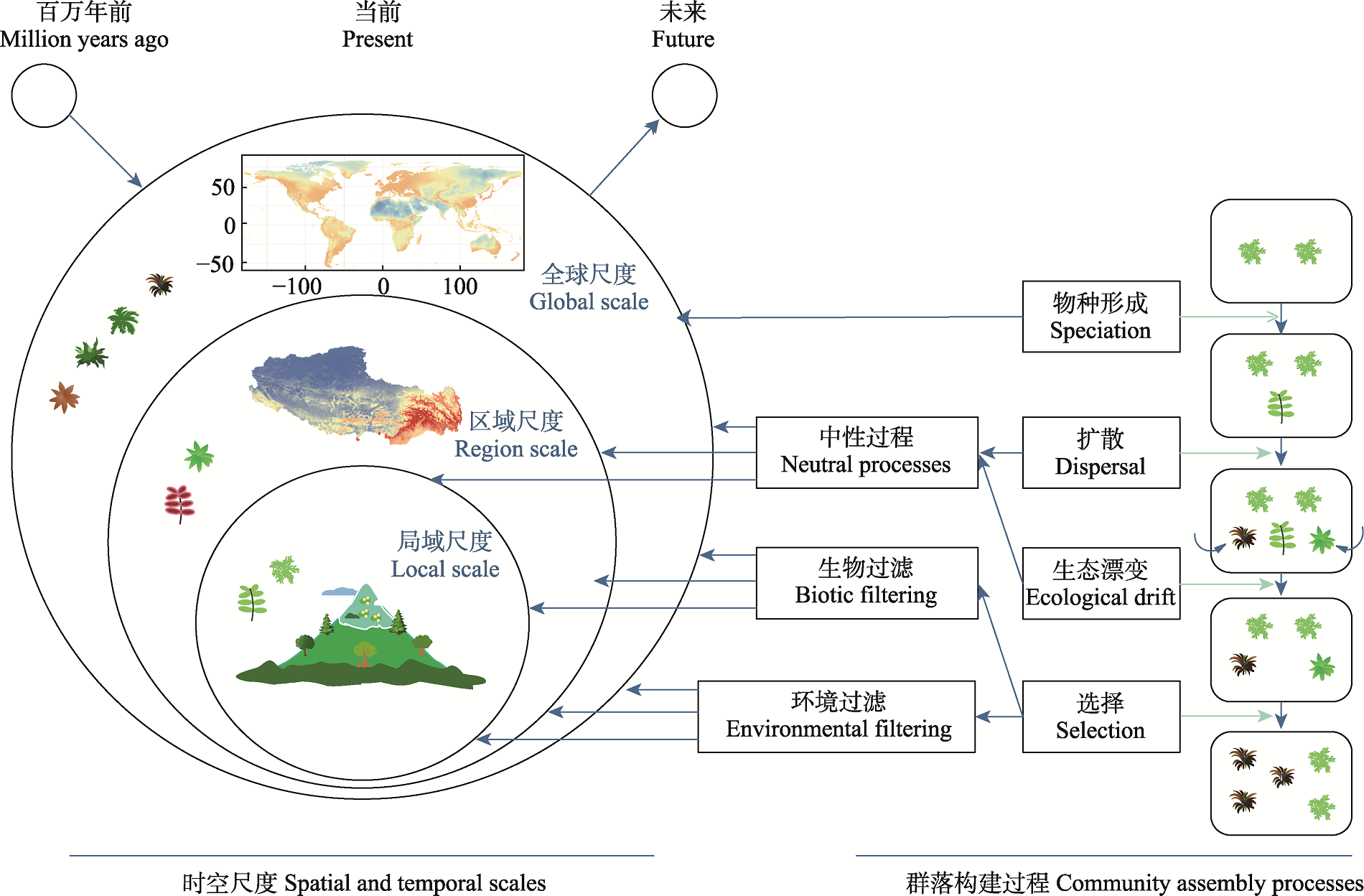
| 图1 群落构建过程的多尺度框架及观测数据类型示意图。图中展示了群落构建过程所处的不同时间与空间尺度, 包括全球尺度、区域尺度与局域尺度。群落构建过程可分为物种形成、中性过程(扩散、生态漂变等)、生物过滤(物种间相互作用)和环境过滤(非生物因子选择)等环节。蓝色箭头表示机制作用方向, 绿色箭头表示不同群落构建过程作用的路径。 |
| Fig. 1 Schematic diagram of the multi-scale framework of community assembly processes and corresponding types of observational data. The figure illustrates the different temporal and spatial scales at which community assembly processes occur, including global, regional, and local scales. Community assembly processes can be divided into speciation, neutral processes (dispersal, ecological drift, etc.), biotic filtering (species interactions), and environmental filtering (selection by abiotic factors). Blue arrows indicate the direction of mechanisms, and green arrows denote the pathways of different community assembly processes. |
|
|