土壤生物多样性与外来植物入侵: 进展与展望
Soil biodiversity and exotic plant invasions: Progress and perspectives
土壤生物多样性与外来植物入侵: 进展与展望 |
| 赵榕江, 吴纪华, 何维明, 赵彩云, 周波, 李博, 杨强 |
|
Soil biodiversity and exotic plant invasions: Progress and perspectives |
| Rongjiang Zhao, Jihua Wu, Weiming He, Caiyun Zhao, Bo Zhou, Bo Li, Qiang Yang |
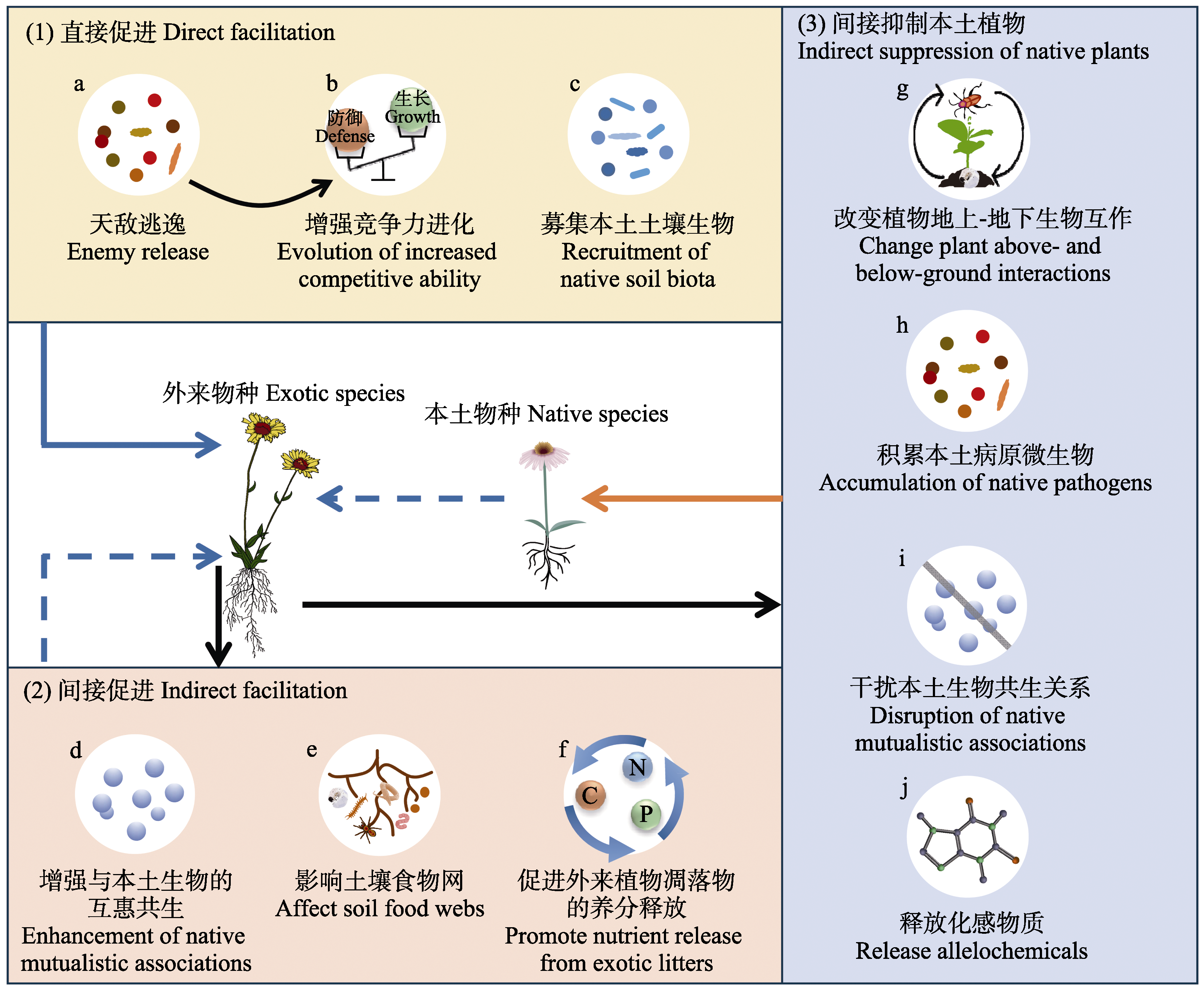
| 图1 土壤生物驱动的外来植物入侵。土壤生物驱动外来植物成功入侵的方式主要分为3类。(1)直接促进: 天敌逃逸(a)和本土土壤生物募集(c)可直接促进外来植物入侵; 外来植物逃离原产地天敌后, 可通过适应性进化(b)增强其对本土植物的竞争力, 进一步加速入侵。(2)间接促进: 外来植物也可通过增强与本土生物的互惠共生(d)、影响土壤食物网(e)、促进自身凋落物的养分释放(f)等间接方式来成功入侵。(3)间接抑制本土植物: 外来植物通过改变植物地上-地下生物互作(g)、积累本土病原微生物(h)、干扰本土生物共生关系(i)、释放化感物质(j)等方式抑制本土植物生长, 间接有利于自身入侵。蓝色箭头表示积极影响, 橙色箭头表示消极影响, 黑色箭头仅表示连接关系。实线箭头表示直接影响, 虚线箭头表示间接影响。 |
| Fig. 1 Soil biota-driven exotic plant invasions. The successful invasion of exotic plants driven by soil biota can be categorized into three main pathways: (1) Direct facilitation: enemy release (a) and recruitment of native soil biota (c) could directly promote exotic plant invasions. Exotic plants could invade through the adaptive evolution of increased competitive ability (b). (2) Indirect facilitation: exotic plants could also benefit in indirect ways, including enhancing native mutualistic associations (d), affecting soil food webs (e), and promoting nutrient release from exotic litters (f). (3) Indirect suppression of native plants: exotic plants could suppress native plants by changing plant above- and below-ground interactions (g), accumulating native pathogens (h), disrupting native mutualistic associations (i), and releasing allelochemicals (j), which are indirectly beneficial to successful invasions. Blue arrows indicate positive effects, orange arrows indicate negative effects, and black arrows indicate connection relationships only; solid arrows indicate direct effects and dashed arrows indicate indirect effects. |
|
|