半干旱草原大中型土壤动物在畜粪分解中的作用
Effects of soil macro- and meso-fauna on the decomposition of cattle and horse dung pats in a semi-arid steppe
半干旱草原大中型土壤动物在畜粪分解中的作用 |
| 程建伟, 王亚东, 王桠楠, 李莹, 郭颖, 白正, 刘新民, 李永宏 |
|
Effects of soil macro- and meso-fauna on the decomposition of cattle and horse dung pats in a semi-arid steppe |
| Jianwei Cheng, Yadong Wang, Yanan Wang, Ying Li, Ying Guo, Zheng Bai, Xinmin Liu, Frank Yonghong Li |
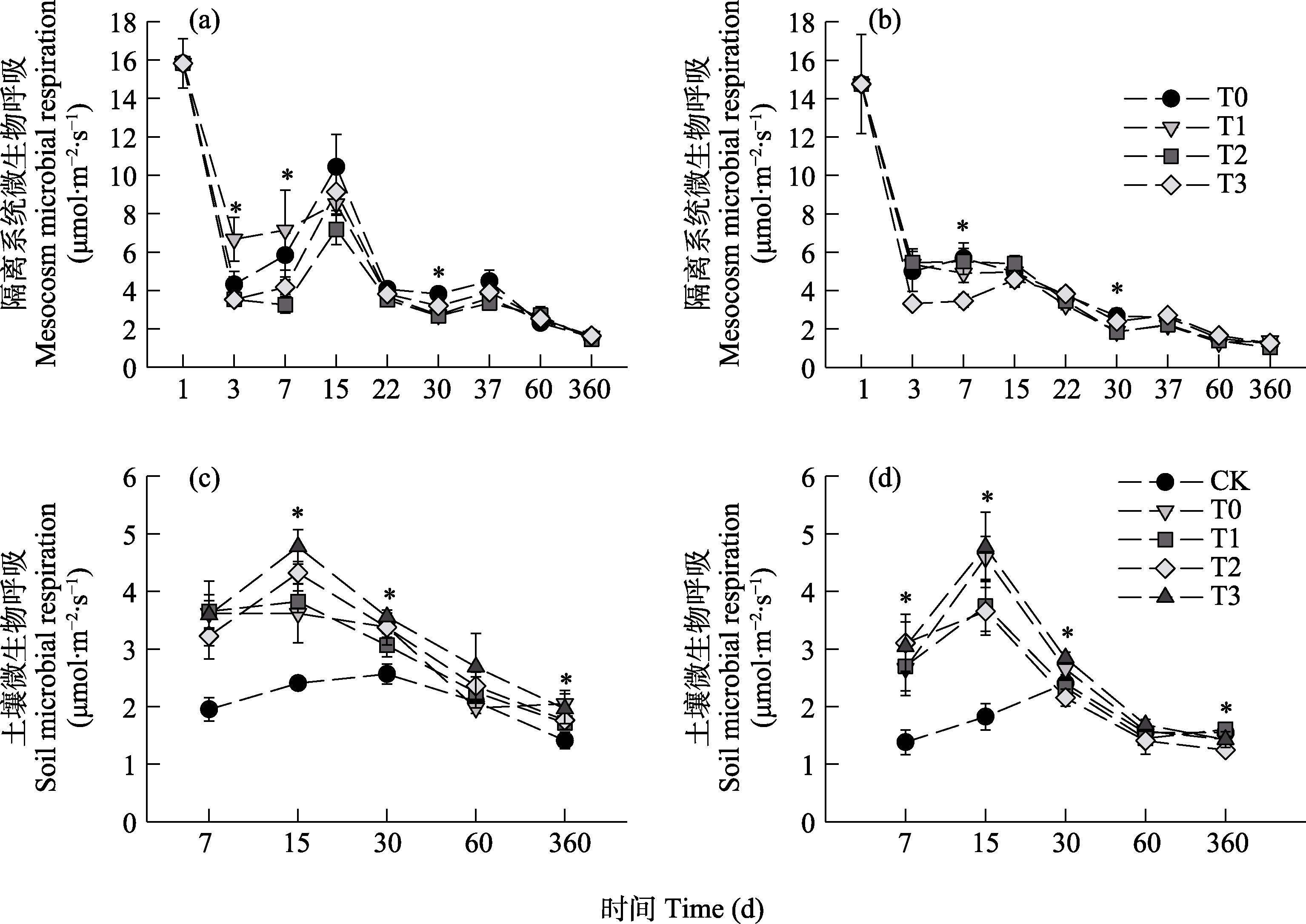
| 图4 畜粪分解一年过程中土壤动物对马粪(a, c)和牛粪(b, d)微生物呼吸的影响。CK, 仅土壤, 无粪; T0, 粪添加+0.425 mm隔离网(排除了粪金龟(粪居型和掘洞型粪金龟)和中型土壤动物); T1, 粪添加+1 mm隔离网(排除了粪金龟); T2, 粪添加+2 mm隔离网(排除了掘洞型粪金龟); T3, 仅粪添加(不排除土壤动物)。采用Duncan检验进行事后比较, *代表不同处理间差异显著(P < 0.05)。 |
| Fig. 4 Microbial respiration (μmol·m?2·s?1) from the mesocosms that contain dung and soil (a: horse, b: cattle) and soil only [after horse dung (c) and cattle dung (d) is removed] under different soil fauna treatments over a 1-year period. CK, Soil only, no dung nor soil fauna; T0, Dung pat covered with a wire-mesh-cage of 0.425 mm holes (excluding dung beetles and soil meso-fauna); T1, Dung pat covered with a wire-mesh-cage of 1 mm holes (excluding dung beetles); T2, Dung pat covered with a wire-mesh-cage of 2 mm holes (excluding tunneler dung beetle); T3, Exposed dung (with no exclusion of soil fauna). The significant differences between treatments at P < 0.05 are denoted using * (one-way ANOVA with Duncan’s multiple-range tests for post hoc comparisons). |
|
|