云南宜良上新世栎属植物研究及其古环境指示意义
Fossil plants of Quercus from the Pliocene of Yiliang, Yunnan Province and their paleoenvironmental implications
云南宜良上新世栎属植物研究及其古环境指示意义 |
| 戴静, 陈威兆, 金露露, 黄亮 |
|
Fossil plants of Quercus from the Pliocene of Yiliang, Yunnan Province and their paleoenvironmental implications |
| Jing Dai, Weizhao Chen, Lulu Jin, Liang Huang |
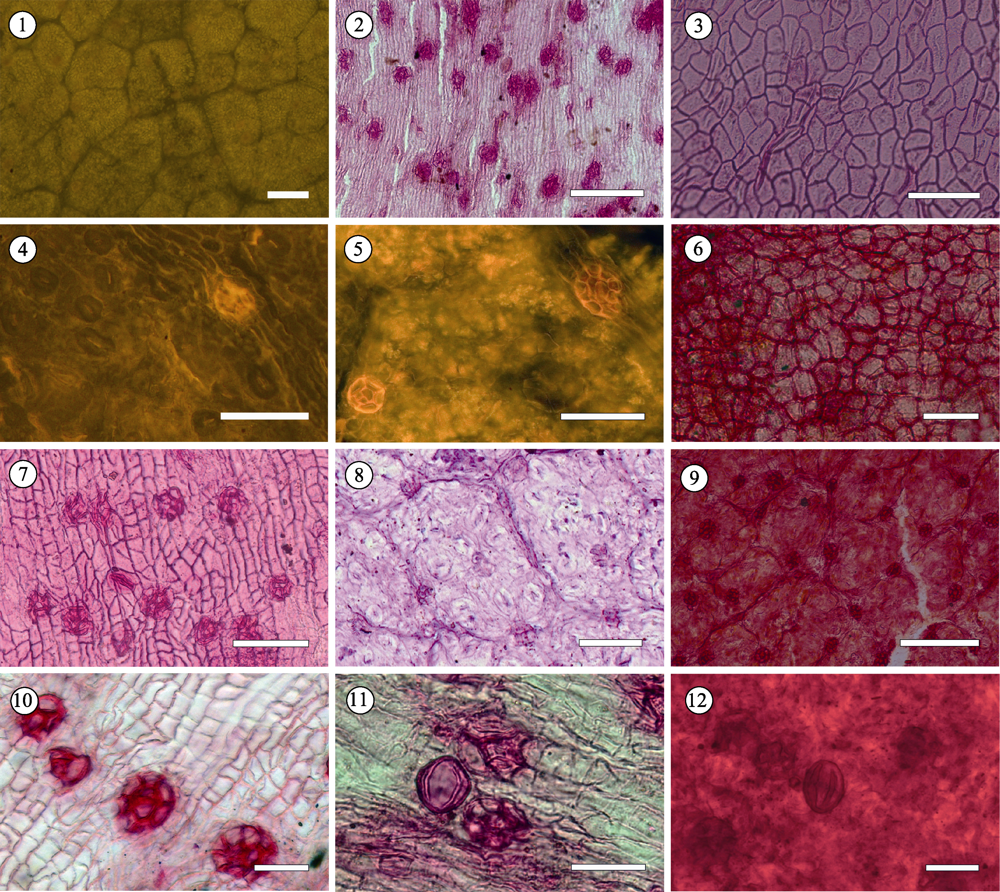
| 图4 楔基栎(1?5)和黄毛青冈相似种(6?10)表皮特征以及叶表面附着的花粉(11?12)。1: 上表皮; 2: 叶脉细胞和毛基; 3: 上表皮细胞; 4: 下表皮, 气孔分布于网眼内; 5: 多细胞复合毛基。6: 上表皮细胞, 垂周壁明显加厚; 7: 叶脉细胞和毛基; 8: 下表皮, 细胞较密集分布于网眼内; 9: 下表皮, 可见单细胞和多细胞复合毛基; 10: 复合毛基。1、9比例尺 = 100 μm; 2?8比例尺 = 50 μm; 10?12比例尺 = 25 μm。 |
| Fig. 4 Cuticular characteristics of Quercus simulata (1?5) and Q.cf. delavayi (6?10), and attached pollen on the leaf surface (11?12). 1, Adaxial epidermis; 2, Epidermal cells and trichome bases on the leaf veins; 3, Adaxial epidermal cells; 4, Stomata distributed in the meshwork; 5, Compound trichome bases. 6, Adaxial Epidermal cells, with obviously thicken anticlinal walls; 7, Trichome bases on the leaf vein; 8, Abaxial epidermis, stomata densely distributed in the meshwork; 9, Abaxial epdermis, with unicellular and multicellular compound trichome bases; 10, Compound trichome base. 1, 9, Scale bar = 50 μm; 2?8, Scale bar = 50 μm; 10?12, Scale bar = 25 μm. |
|
|