A dataset describing the community characteristics and geographic distribution of Krascheninnikovia compacta
- Jiahe Cui ,
- Zhiyong Li ,
- Yuchi Wang ,
- Qiang Sun ,
- Na Sha ,
- Zijing Li ,
- Yantao Wu ,
- Yabo Shi ,
- Ying Han ,
- Mingle Li ,
- Lixin Wang ,
- Liqing Zhao ,
- Cunzhu Liang
- 1. School of Ecology and Environment, Inner Mongolia University, Hohhot 010021
2. Key Laboratory of Ecology and Resource Use of the Mongolian Plateau, Ministry of Education, Hohhot 010021
3. Collaborative Innovation Center for Grassland Ecological Security (Jointly Supported by the Ministry of Education and Inner Mongolia Autonomous Region), Hohhot 010021
4. College of Resources Environment and Tourism, Capital Normal University, Beijing 100048
5. Institute of Water Resources for Pastoral Area, Ministry of Water Resources, Hohhot 010020
Received date: 2023-05-29
Accepted date: 2023-09-05
Online published: 2023-11-30
Abstract
The Krascheninnikovia compacta community is primarily distributed in extremely cold and arid high-altitude environments typically inaccessible to humans. It represents the most common and widely distributed type of vegetation in the alpine deserts of the Qingzang Plateau. Most investigations into this community take the form of qualitative descriptions, which fail to provide precious sample data. In order to generate a community dataset of K. compacta, this paper recorded and organized the spatial distribution, community characteristics and structure, and climate characteristics of this species based on field survey data collected in 2018, 2019, and 2022, along with a description of the relevant literature. The results showed that: (1) Krascheninnikovia compacta community was mainly found in the Central Kunlun Mountains of the Qingzang Plateau, the Northern Tianshan Mountains, the Altun Mountains, and the Dangjin Mountains Pass. (2) Krascheninnikovia compacta community had the relatively low values in community height, coverage, biomass and species richness. Our study identified 29 species of seed plants belonging to 11 families and 22 genera distributed among 22 typical plots. Hemicryptophytes were the dominant life form, with a total of 18 species, which accounted for 62.07% of all plants and primarily consisted of perennial grasses and perennial weeds. (3) The community structure was relatively simple due to only K. compacta having a consistent presence of more than 50% of all species. There were several subdominant species but mostly companion species and occasional species (93.10%) residing in the shrub layer and herb layer. (4) The vertical structure of the community can be divided into two layers. The first layer consists of a sparse cushioned small semi-shrub dominated by K. compacta, and the second layer consists of a sparse herb layer. (5) The growth environment of this community was characterized by a cold climate and little precipitation that is concentrated in the warmest quarter of the alpine desert climate. This dataset is the only known dataset describing the K. compacta community in China. It represents a valuable resource for studying the species composition and structure of the K. compacta community. The information regarding the geographic climate and community species in the dataset provides basic data for future investigation of Krascheninnikovia compacta community and compilation of Vegegraphy of China.
Database/Dataset Profile
| Title | A dataset describing the community characteristics and geographic distribution of Krascheninnikovia compacta |
|---|---|
| Authors | Jiahe Cui, Zhiyong Li, Yuchi Wang, Qiang Sun, Na Sha, Zijing Li, Yantao Wu, Yabo Shi, Ying Han, Mingle Li, Lixin Wang, Liqing Zhao, Cunzhu Liang |
| Corresponding author | Cunzhu Liang (bilcz@imu.edu.cn) |
| Time range | 2018-2022 |
| Geographical scope | Xizang, Xinjiang, Gansu |
| File size | 909.64 MB |
| Data format | *.zip |
| Data link | https://www.scidb.cn/s/niIZFf https://doi.org/10.57760/sciencedb.13467 https://www.biodiversity-science.net/fileup/1005-0094/DATA/2023172.zip |
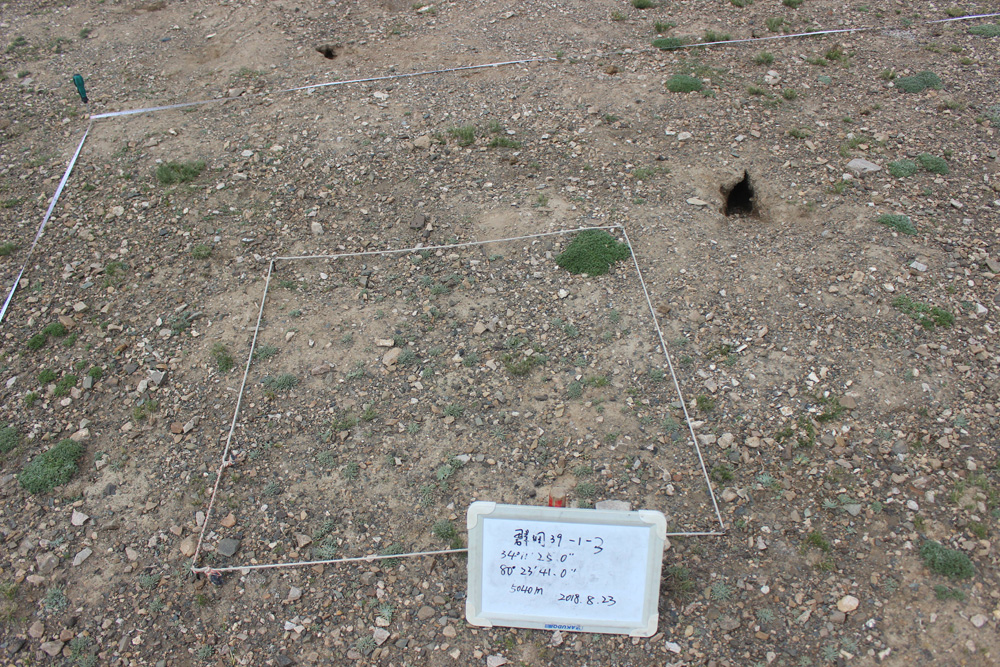
| Database/Dataset composition | This dataset consists of two files. File 1: A quadrat photo dataset of Krascheninnikovia compacta community, which is divided into 14 subfiles according to the survey plots. Each subfile includes quadrat photos, environment photos, and sample description of plot. It contains 97 quadrat photos and 14 quadrat descriptions in total. All subfiles are named after plot number and photos are named after plot-quadrat-replicate. File 2: A dataset describing the community characteristics and geographic distribution of Krascheninnikovia compacta, which contains 3 work sheets: 1. Geographic and climatic information of the community plots; 2. Survey data of plots; 3. Species diversity information of the community. |
Cite this article
Jiahe Cui , Zhiyong Li , Yuchi Wang , Qiang Sun , Na Sha , Zijing Li , Yantao Wu , Yabo Shi , Ying Han , Mingle Li , Lixin Wang , Liqing Zhao , Cunzhu Liang . A dataset describing the community characteristics and geographic distribution of Krascheninnikovia compacta[J]. Biodiversity Science, 2023 , 31(10) : 23172 . DOI: 10.17520/biods.2023172
References
| [1] | Chen GC, Peng M, Huang RF, Lu XF (1994) Vegetation characteristics and its distribution of Qilian Mountain region. Acta Botanica Sinica, 36, 63-72. (in Chinese with English abstract) |
| [1] | [陈桂琛, 彭敏, 黄荣福, 卢学峰 (1994) 祁连山地区植被特征及其分布规律. 植物学报, 36, 63-72.] |
| [2] | Cui HX, Wang B, Qi G, Zhang YC (1988) Vegetation types in the north slope and inner plain of the Kunlun Mountains. Acta Phytoecologica et Geobotanica Sinica, 12, 91-103. (in Chinese with English abstract) |
| [2] | [崔恒心, 王博, 祁贵, 张筱淳 (1988) 中昆仑山北坡及内部山原的植被类型. 植物生态学与地植物学学报, 12, 91-103.] |
| [3] | Deng LY, Liu FX, Bao CZ, Qiao BJ (1983) The types of grassland in Xizang and the evaluation of their resources. Acta Phytoecologica et Geobotanica Sinica, 7, 136-142. (in Chinese) |
| [3] | [邓立友, 刘奉贤, 包纯志, 乔炳钧 (1983) 西藏草地类型及其资源评价. 植物生态学与地植物学学报, 7, 136-142.] |
| [4] | Delecti Florae Reipublicae Popularis Sinicae Agendae Academiae Sinicae (1979) Flora Reipublicae Popularis Sinica, Vol. 25. Science Press, Beijing. (in Chinese) |
| [4] | [中国科学院中国植物志编辑委员会 (1979) 中国植物志(第25卷). 科学出版社, 北京.] |
| [5] | Fang JY, Wang XP, Shen ZH, Tang ZY, He JS, Yu D, Jiang Y, Wang ZH, Zheng CY, Zhu JL, Guo ZD (2009) Methods and protocols for plant community inventory. Biodiversity Science, 17, 533-548. (in Chinese with English abstract) |
| [5] | [方精云, 王襄平, 沈泽昊, 唐志尧, 贺金生, 于丹, 江源, 王志恒, 郑成洋, 朱江玲, 郭兆迪 (2009) 植物群落清查的主要内容、方法和技术规范. 生物多样性, 17, 533-548.] |
| [6] | Guo K (1993) Vegetation of Qinghai Hoh Xil region. Acta Phytoecologica et Geobotanica Sinica, 17, 120-132. (in Chinese with English abstract) |
| [6] | [郭柯 (1993) 青海可可西里地区的植被. 植物生态学与地植物学学报, 17, 26-38.] |
| [7] | Li BS, Wang JT, Li SY (1987) The floristic features and geographic distribution of the cushion plant in Xizang. Mountain Research, 5, 14-20. (in Chinese with English abstract) |
| [7] | [李渤生, 王金亭, 李世英 (1987) 西藏座垫植物的区系特点及地理分布. 山地研究, 5, 14-20.] |
| [8] | Li BS, Zhang JW, Wang JT, Chen WL (1985) The alpine vegetation of Xizang. Acta Botanica Sinica, 27, 311-317. (in Chinese with English abstract) |
| [8] | [李渤生, 张经炜, 王金亭, 陈伟烈 (1985) 西藏的高山座垫植被. 植物学报, 27, 311-317.] |
| [9] | Liu SE (1934) Introduction to plant geography of North and West China. Contributions from the Laboratory of Botany National Academy of Peiping, 2, 423-448. (in Chinese) |
| [9] | [刘慎谔 (1934) 中国北部及西部植物地理概论. 国立北平研究院植物学研究所丛刊, 2, 423-448.] |
| [10] | Qian CS, Wu ZY, Chen CD (1956) The vegetation types of China. Acta Geographica Sinica, 22, 37-90. (in Chinese with English abstract) |
| [10] | [钱崇澍, 吴征镒, 陈昌笃 (1956) 中国植被的类型. 地理学报, 22, 37-92.] |
| [11] | Qinghai-Tibet Plateau Comprehensive Science Expedition, Chinese Academy of Sciences (1998) Vegetation in Xizang. Science Press, Beijing. (in Chinese) |
| [11] | [中国科学院青藏高原综合科学考察队 (1988) 西藏植被. 科学出版社, 北京.] |
| [12] | The Biodiversity Committee of Chinese Academy of Sciences (2023) Catalogue of Life China:2023 Annual Checklist. Beijing. (in Chinese and in English) |
| [12] | [中国科学院生物多样性委员会 (2023) 中国生物物种名录(2023版). 北京, 中国.] http://www.sp2000.org.cn/database/show_database_details/ff53a6a6-b13e-4f46-a73a-0028897bf93a/. (accessed on 2023-05-23) |
| [13] | Wang JT (1988) The steppes and deserts of the Xizang Plateau. Plant Ecology, 75, 135-142. |
| [14] | Wang JT, Li BS (1982) Main types and characteristics of high-cold steppe in the Qiangtang Plateau of Xizang. Acta Phytoecologica et Geobotanica Sinica, 6, 1-13. (in Chinese with English abstract) |
| [14] | [王金亭, 李渤生 (1982) 西藏羌塘高原高寒草原的基本类型与特征. 植物生态学与地植物学学报, 6, 1-13.] |
| [15] | Wang JT, Li BS, Chen WL, Zhang JW (1980) Basic characteristics of grassland vegetation in Tibet Plateau. Acta Botanica Sinica, 22, 161-169. (in Chinese with English abstract) |
| [15] | [王金亭, 李渤生, 陈伟烈, 张经炜 (1980) 西藏高原草原植被的基本特征. 植物学报, 22, 161-169.] |
| [16] | Wang YF, Wang JL (2006) Study on the Chenopodiaceae in Gansu. Bulletin of Botanical Research, 26, 742-749. (in Chinese with English abstract) |
| [16] | [王一峰, 王俊龙 (2006) 甘肃藜科植物研究. 植物研究, 26, 742-749.] |
| [17] | Wu ZY (1980) Vegetation of China. Science Press, Beijing. (in Chinese) |
| [17] | [吴征镒 (1980) 中国植被. 科学出版社, 北京.] |
| [18] | Wu ZY, Raven PH, Hong DY (2003) Flora of China, Vol. 5. Science Press, Beijing & Missouri Botanical Garden, St. Louis. |
| [19] | Xinjiang Comprehensive Expedition, Chinese Academy of Sciences (1978) Vegetation and Its Utilization in Xinjiang. Science Press, Beijing. (in Chinese) |
| [19] | [中国科学院新疆综合考察队 (1978) 新疆植被及其利用. 科学出版社, 北京.] |
| [20] | Zhang LY, Zhang XM (1987) Vegetation of Kumukuri Basin. Chinese Grassland, (1), 3-10. (in Chinese with English abstract) |
| [20] | [张立运, 张希明 (1987) 库木库里盆地的植被. 中国草原, (1), 3-10.] |
| [21] | Zhang WK, Li H, Wang GH (2013) Community characteristics of main vegetation types along two altitudinal transects on mountains of northwestern Beijing, China. Chinese Journal of Plant Ecology, 37, 566-570. (in Chinese with English abstract) |
| [21] | [张维康, 李贺, 王国宏 (2013) 北京西北部山地两个垂直样带内主要植被类型的群落特征. 植物生态学报, 37, 566-570.] |
| [22] | Zhang XS (1978) The plateau zonality of vegetation in Xizang. Acta Botanica Sinica, 20, 140-149. (in Chinese with English abstract) |
| [22] | [张新时 (1978) 西藏植被的高原地带性. 植物学报, 20, 140-149.] |
| [23] | Zhao HW, Guo K, Qiao XG, Liu CC (2017) The ecogeographical characteristics of Ceratoides compacta alpine desert on the Tibetan Plateau. Geographical Research, 36, 2441-2450. (in Chinese with English abstract) |
| [23] | [赵海卫, 郭柯, 乔鲜果, 刘长成 (2017) 青藏高原垫状驼绒藜高寒荒漠的生态地理特征. 地理研究, 36, 2441-2450.] |
| [24] | Zheng D, Zhang RZ, Yang QY (1979) Try to discuss the natural zone of Qinghai Tibet Plateau. Acta Geographica Sinica, 34, 1-11. (in Chinese with English abstract) |
| [24] | [郑度, 张荣祖, 杨勤业 (1979) 试论青藏高原的自然地带. 地理学报, 34, 1-11.] |
| [25] | Zheng D, Zhao DS (2019) The high cold desert zone and a cold-arid core area of the Tibetan Plateau. Arid Zone Research, 36, 1-6. (in Chinese with English abstract) |
| [25] | [郑度, 赵东升 (2019) 青藏高原高寒荒漠地带与寒冷干旱核心区域. 干旱区研究, 36, 1-6.] |
| [26] | Zhong BQ (1954) General situation of plants and their distribution in Tibet Plateau. Bulletin of Biology, (10), 10-13. (in Chinese) |
| [26] | [钟补求 (1954) 西藏高原的植物及其分布概况. 生物学通报, (10), 10-13.] |
| [27] | Zhuo L, Zhang ML, Yin LK (2010) Distribution and floristic characteristics of Atriplicioides in China. Arid Zone Research, 27, 324-330. (in Chinese with English abstract) |
| [27] | [卓立, 张明理, 尹林克 (2010) 中国滨藜亚科的地理分布格局及特点. 干旱区研究, 27, 324-330.] |