Diversity of endophytic bacteria in five types of tissues of Hippophae tibetana
- College of Life Sciences, Northwest Normal University, Lanzhou 730070
Received date: 2021-01-25
Accepted date: 2021-04-22
Online published: 2021-05-28
Abstract
Aims: Hippophae tibetana is a special kind of actinorhizal plants distributed in severe cold and high altitude areas. Frankia spp. can infect its roots and form nodules, which enhances its ecological adaptability due to symbiotic nitrogen fixation and other effects. Besides Frankia spp., there are other endophytic bacteria in the root nodules of H. tibetana. Frankia spp. can distribute not only nodules but also other tissues. By analyzing the community structure and diversity of endophytic bacteria in different tissues, the clonization and possible migration of Frankia in different tissues were discussed.
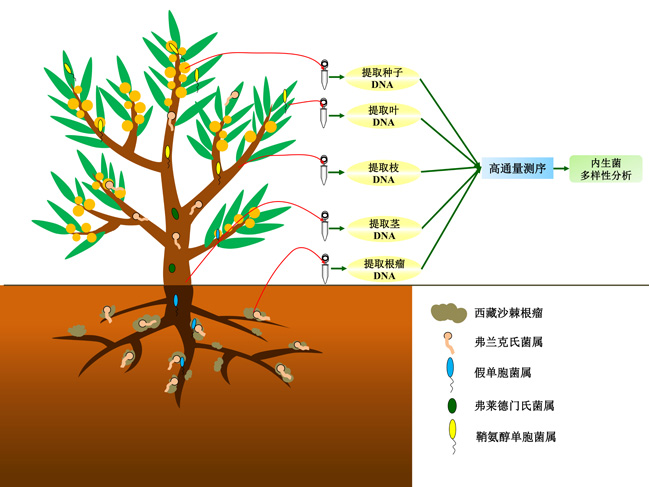
Methods: High-throughput sequencing of the V5‒V7 region of 16S rRNA gene was used to study the diversity of Frankia spp. and other endophytic bacteria in root nodules, stems, branches, leaves, and seeds of H. tibetana,.
Results: The results showed that the richness and diversity indices of the community in the root nodules of H. tibetana were the highest, while the richness of endophytic bacterial community in seeds were the lowest, and diversity indices in the stems were the lowest. The diversity of endophytic bacterial communities in five types of tissues of H. tibetana was different. Proteobacteria were the dominant phylum of the endophytic bacterial communities of five tissue types, Frankia was the dominant genus in root nodules, while Friedmanniella was the dominant genus in stems, and Stenotrophomonas was the dominant genus in branches, leaves, and seeds. The results also showed that Frankia could not only colonize in root nodules of H. tibetana, but also distributed in other tissues. There were different “species” of Frankia in the same tissue type of H. tibetana, and the same “species” of Frankia were also distributed in different tissues. In addition, functional endophytic bacteria existed in five tissue types of H. tibetana, which can fix nitrogen, promote the growth inhibit pathogens of host plants. Endophytic bacteria with nitrogen fixation function were mainly distributed in nodules, while those with growth-promoting and bacteriostatic functions were mainly distributed in branches and leaves of H. tibetana.
Conclusion: There were rich diversity of endophytic bacteria in five tissue types of H. tibetana, but the community structure and dominant population of each tissue were different, and different tissues could also colonize endophytic bacteria with multiple functions.
Key words: Hippophae tibetana; tissues; endophytic bacteria; diversity; Frankia spp.; functional strain
Cite this article
Aimei Zhang , Yiran Yin , Weibao Kong , Xuetai Zhu , Yingli Yang . Diversity of endophytic bacteria in five types of tissues of Hippophae tibetana[J]. Biodiversity Science, 2021 , 29(9) : 1236 -1244 . DOI: 10.17520/biods.2021034
References
| [1] | Afzal I, Shinwari ZK, Sikandar S, Shahzad S (2019) Plant beneficial endophytic bacteria: Mechanisms, diversity, host range and genetic determinants. Microbiological Research, 221, 36-49. |
| [2] | Beckers B, Beeck MOD, Weyens N, Boerjan W, Vangronsveld J (2017) Structural variability and niche differentiation in the rhizosphere and endosphere bacterial microbiome of field-grown poplar trees. Microbiome, 5, 25. |
| [3] | Cai XY, Liu YC, Xie ZH, Chen YL, Liu RJ (2020) Research advances in mutualistic symbiotic microbes diversities. Microbiology China, 47, 3899-3917. (in Chinese with English abstract) |
| [3] | [蔡昕悦, 刘耀臣, 解志红, 陈应龙, 刘润进 (2020) 互惠共生微生物多样性研究概况. 微生物学通报, 47, 3899-3917.] |
| [4] | Cao K, Wang XN, Sun YF, Li ZW, Pan DM, Zhao Y (2017) Research progress on endophytic bacterial diversity and biocontrol of plant roots. Agriculture and Technology, 37(17), 1-3, 5. (in Chinese) |
| [4] | [曹焜, 王晓楠, 孙宇峰, 李振伟, 潘冬梅, 赵越 (2017) 植物根部内生细菌多样性及其生防作用研究进展. 农业与技术, 37(17), 1-3, 5.] |
| [5] | Chaia EE, Wall LG, Huss-Danell K (2010) Life in soil by the actinorhizal root nodule endophyte Frankia. A review. Symbiosis, 51, 201-226. |
| [6] | Chen ZY, Liu J, Yang XP, Liu M, Wang Y, Zhang ZB, Zhu D (2019) Community composition and diversity of cultivable endophytic bacteria isolated from Dongxiang wild rice. Biodiversity Science, 27, 1320-1329. (in Chinese with English abstract) |
| [6] | [陈志远, 刘珺, 杨星鹏, 刘梦, 汪涯, 张志斌, 朱笃 (2019) 东乡野生稻可培养内生细菌群落组成及多样性. 生物多样性, 27, 1320-1329.] |
| [7] | Du XN, Xu HJ, Huang PP, Dai JX (2015) Diversity and antimicrobial activity of endophytic bacteria isolated from Lycium barbarum of Ningxia. Microbiology China, 42, 1779-1787. (in Chinese with English abstract) |
| [7] | [杜晓宁, 徐惠娟, 黄盼盼, 代金霞 (2015) 宁夏枸杞内生细菌的多样性及其抑菌活性研究. 微生物学通报, 42, 1779-1787.] |
| [8] | Gu MY, Gulinisha S, Zhang ZD, Zhu J, Liu XJ, Tang QY, Outikuer M, Song SQ, Feng L, Tang GM, Xu WL (2021) Diversity and function analysis of endophytic bacterial community in different tissues of Lycium ruthenicum Murr. Acta Microbiologica Sinica, 61, 152-166. (in Chinese with English abstract) |
| [8] | [顾美英,古丽尼沙·沙依木, 张志东, 朱静, 刘晓静, 唐琦勇, 欧提库尔·玛合水提, 宋素琴, 冯雷, 唐光木, 徐万里 (2021) 黑果枸杞不同组织内生细菌群落多样性. 微生物学报, 61, 152-166.] |
| [9] | Hallmann J, Quadt-Hallmann A, Mahaffee WF, Kloepper JW (1997) Bacterial endophytes in agricultural crops. Canadian Journal of Microbiology, 43, 895-914. |
| [10] | He LM, Ye JR (2014) Endophytic bacteria: Research advances and biocontrol applications. Journal of Nanjing Forestry University (Natural Sciences Edition), 38, 153-159. (in Chinese with English abstract) |
| [10] | [何玲敏, 叶建仁 (2014) 植物内生细菌及其生防作用研究进展. 南京林业大学学报(自然科学版), 38, 153-159.] |
| [11] | Kim H, Rim SO, Bae H (2019) Antimicrobial potential of metabolites extracted from ginseng bacterial endophyte Burkholderia stabilis against ginseng pathogens. Biological Control, 128, 24-30. |
| [12] | Marag PS, Suman A (2018) Growth stage and tissue specific colonization of endophytic bacteria having plant growth promoting traits in hybrid and composite maize (Zea mays L.). Microbiological Research, 214, 101-113. |
| [13] | Ning CH, Li WB, Liu RJ (2019) Research advances in plant symbiotic actinomyces. Chinese Journal of Ecology, 38, 256-266. (in Chinese with English abstract) |
| [13] | [宁楚涵, 李文彬, 刘润进 (2018) 植物共生放线菌研究进展. 生态学杂志, 38, 256-266.] |
| [14] | Sha YX (2018) Diversity of bacterial endophytic community in different rice tissues. Acta Microbiologica Sinica, 58, 2216-2228. (in Chinese with English abstract) |
| [14] | [沙月霞 (2018) 不同水稻组织内生细菌的群落多样性. 微生物学报, 58, 2216-2228.] |
| [15] | Song CJ, Ma KM, Fu BJ, Qu LY, Liu Y (2009) A review on the functions of nitrogen-fixers in terrestrial ecosystems. Acta Ecologica Sinica, 29, 869-877. (in Chinese with English abstract) |
| [15] | [宋成军, 马克明, 傅伯杰, 曲来叶, 刘杨 (2009) 固氮类植物在陆地生态系统中的作用研究进展. 生态学报, 29, 869-877.] |
| [16] | Tian CJ, He XY, Zhong Y, Chen JK (2002) Effects of VA mycorrhizae and Frankia dual inoculation on growth and nitrogen fixation of Hippophae tibetana. Forest Ecology and Management, 170, 307-312.] |
| [17] | Wang ZW, Ji YL, Chen YG (2015) Studies and biological significances of plant endophytes. Microbiology China, 42, 349-363. (in Chinese with English abstract) |
| [17] | [王志伟, 纪燕玲, 陈永敢 (2015) 植物内生菌研究及其科学意义. 微生物学通报, 42, 349-363.] |
| [18] | Xu GQ, Liu YX, Cao PX, Liu X (2021) Core microflora and endophytic interaction network of Oxytropis glacialis in Qinghai-Tibet Plateau. Microbiology China, 47, 2746-2758 (in Chinese with English abstract) |
| [18] | [许国琪, 刘怡萱, 曹鹏熙, 刘星 (2021) 青藏高原冰川棘豆(Oxytropis glacialis)内生菌核心微生物组的界定及其互作网络分析. 微生物学通报, 47, 2746-2758.] |
| [19] | Xu WF, Wang F, Zhang M, Ou T, Wang RL, Strobel G, Xiang ZH, Zhou ZY, Xie J (2019) Diversity of cultivable endophytic bacteria in mulberry and their potential for antimicrobial and plant growth-promoting activities. Microbiological Research, 229, 126328. |
| [20] | Zhang AM, Niu SQ, Sun K, Cao WX, Da WY (2010) Study on the root nodules features of Hippophae and Frankia isolation. Grassland and Turf, 30(2), 43-46. (in Chinese with English abstract) |
| [20] | [张爱梅, 牛世全, 孙坤, 曹文侠, 达文燕 (2010) 沙棘属植物结瘤特性及Frankia根瘤菌分离. 草原与草坪, 30(2), 43-46.] |
| [21] | Zhang AM, Han XY, Sun K, Zhang SH, Kong WB, Niu SQ, Zhu XT (2018a) Root nodules endophytic and rhizosphere soil bacteria diversity of Hippophae rhamnoides subsp. sinensis based on high-throughput sequencing. Grassland and Turf, 38(2), 49-55. (in Chinese with English abstract) |
| [21] | [张爱梅, 韩雪英, 孙坤, 张世虎, 孔维宝, 牛世全, 朱学泰 (2018a) 高通量测序分析中国沙棘根瘤与根际土壤细菌多样性. 草原与草坪, 38(2), 49-55.] |
| [22] | Zhang AM, Han XY, Zhang SH, Sun K, Wu JY, Yu J, Guo BM (2018b) Diversity of root nodule endophytic bacteria in Hippophae tibetana at different altitudes in Gannan area. Biotic Resources, 40, 114-119. (in Chinese with English abstract) |
| [22] | [张爱梅, 韩雪英, 张世虎, 孙坤, 吴菊艳, 于杰, 郭保民 (2018b) 甘南高寒地区不同海拔西藏沙棘根瘤内生菌多样性. 生物资源, 40, 114-119.] |
| [23] | Zhang AM, Han XY, Wang J, Kong WB, Niu SQ, Zhu XT (2019a) Diversity of endophytic bacteria in root nodules of Hippophae rhamnoides in the Maxian Mountains. Acta Ecologica Sinica, 39, 294-301. (in Chinese with English abstract) |
| [23] | [张爱梅, 韩雪英, 王嘉, 孔维宝, 牛世全, 朱学泰 (2019a) 马衔山中国沙棘根瘤内共生细菌多样性研究. 生态学报, 39, 294-301.] |
| [24] | Zhang AM, Wu JY, Han XY, Kong WB (2019b) Screening and identification of antagonistic and plant-growth promoting endophytic bacteria from Seabuckthorn nodules. Microbiology China, 46, 1041-1051. (in Chinese with English abstract) |
| [24] | [张爱梅, 吴菊艳, 韩雪英, 孔维宝 (2019b) 沙棘根瘤内生细菌中抑菌促生菌株的筛选和鉴定. 微生物学通报, 46, 1041-1051.] |
| [25] | Zhang AM, Yin YR, Sun K (2020a) Research progress in Frankia spp. associated with Hippophae L. Microbiology China, 47, 3933-3944. (in Chinese with English abstract) |
| [25] | [张爱梅, 殷一然, 孙坤 (2020) 沙棘属植物弗兰克氏菌研究进展. 微生物学通报, 47, 3933-3944.] |
| [26] | Zhang AM, Guo BM, Han XY, Li XR (2020b) Diversity of endophytic bacteria in seeds of Hippophae rhamnoides subsp. sinensis in two different habitats. Acta Ecologica Sinica, 40, 5247-5257. (in Chinese with English abstract) |
| [26] | [张爱梅, 郭保民, 韩雪英, 李曦冉 (2020b) 两种不同生境中国沙棘种子内生细菌的多样性. 生态学报, 40, 5247-5257.] |
| [27] | Zhang T, Li Y, Xiong J, Xu XH, Lan CH, Tian BY (2020) Community composition and differential analysis of endophytic bacteria in different niches of tomato. Genomics and Applied Biology, 39, 5558-5566. (in Chinese with English abstract) |
| [27] | [张婷, 黎烨, 熊娟, 许小红, 蓝灿华, 田宝玉 (2020) 番茄不同生态位内生菌的菌群结构组成和差异性分析, 39, 5558-5566.] |