Overview of Sanjiangyuan Community-based Camera-trapping Monitoring Platform
- 1 Center for Nature and Society, College of Life Sciences, Peking University, Beijing 100871
2 Shanshui Conservation Center, Beijing 100871
3 Department of Health and Environmental Sciences, Xi’an Jiaotong-Liverpool University, Suzhou, Jiangsu 215123
Received date: 2020-06-28
Accepted date: 2020-07-31
Online published: 2020-09-20
Abstract
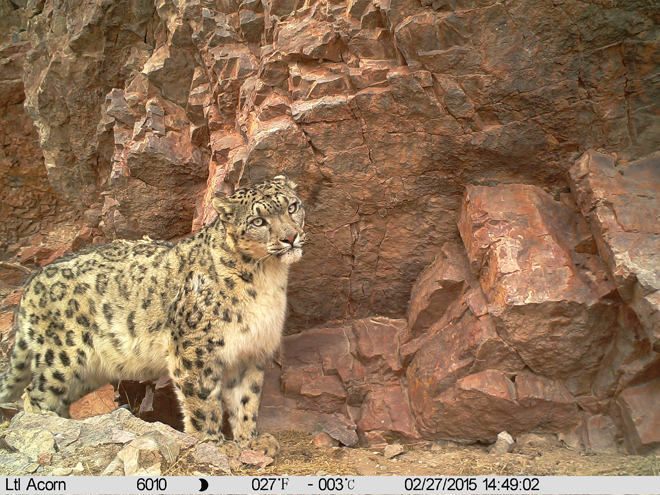
The Sanjiangyuan Community-based Camera-trapping Monitoring Platform relies on the help of local Tibetan herders with nature conservation efforts. This platform uses infrared-triggered camera trapping, which is important for research on Sanjiangyuan wildlife ecology, animal behavior, biodiversity monitoring, and evaluation of community management for conservation. The platform was established in October 2013 by Center for Nature and Society of Peking University and Shanshui Conservation Center. As of June 2019, the platform has 9 functional monitoring sites with 264 local rangers in Yushu Prefecture and Banma County in Guoluo Prefecture, covering an area of about 7,000 km 2. We obtained 2,524,300 pictures resulting in 120,000 independent detections and documented 30 mammal and 37 bird species. This data has been used in surveying wildlife richness, accessing density and population dynamics of snow leopards (Panthera uncia), studying the inter-species relationship between snow leopards and co-occurring carnivores, and sharing management experience of community-based monitoring. The future directions for this platform will be to further summarize and publish the research results from the database, build a cloud-based database for better data sharing and public participation, establish an interactive management platform for national park administrators with the application of handhold terminals designed for national park rangers, and to identify species and snow leopard individuals via artificial intelligence.
Cite this article
Ding Jia , Peiyun Li , Xiang Zhao , Chen Cheng , Lingyun Xiao , Zhi Lü . Overview of Sanjiangyuan Community-based Camera-trapping Monitoring Platform[J]. Biodiversity Science, 2020 , 28(9) : 1104 -1109 . DOI: 10.17520/biods.2019322
References
| [1] | Jiang ZG, Liu SY, Wu Y, Jiang XL, Zhou KY (2017) China’s mammal diversity (2nd edition). Biodiversity Science, 25, 886-895.(in Chinese with English abstract) |
| [1] | [ 蒋志刚, 刘少英, 吴毅, 蒋学龙, 周开亚 (2017) 中国哺乳动物多样性(第2版). 生物多样性, 25, 886-895.] |
| [2] | Li S, Wang DJ, Xiao ZS, Li XH, Wang TM, Feng LM, Wang Y (2014) Camera-trapping in wildlife research and conservation in China: Review and outlook. Biodiversity Science, 22, 685-695.(in Chinese with English abstract) |
| [2] | [ 李晟, 王大军, 肖治术, 李欣海, 王天明, 冯利民, 王云 (2014) 红外相机技术在我国野生动物研究与保护中的应用与前景. 生物多样性, 22, 685-695.] |
| [3] | MacRinnon J, Phillipps K, He FQ (2000) A Field Guide to the Birds of China, Hunan Education Press. Changsha.(in Chinese) |
| [3] | [ 约翰·马敬能 卡伦·菲利普斯 何芬奇 (2000) 中国鸟类野外手册, 湖南教育出版社, 长沙.] |
| [4] | Mei S, Alexander JS, Zhao X, Cheng C, Lü Z (2018) Common leopard and snow leopard coexistence in Sanjiangyuan, Qinghai, China. Cat News, 18-20. |
| [5] | Michalski F, Peres CA (2007) Disturbance-mediated mammal persistence and abundance-area relationships in Amazonian forest fragments. Conservation Biology, 21, 1626-1640. |
| [6] | Smith AT, Xie Y (2009) A Guide to the Mammals of China, Hunan Education Press, Changsha.(in Chinese) |
| [6] | [ Smith AT, 解焱 (2009) 中国兽类野外手册. 湖南教育出版社, 长沙.] |
| [7] | Xiao LY, Cheng C, Wan HW, Zhang DH, Wang YC, Cai D, Hou P, Li J, Liu YP, Yang X, Lü Z (2019) Define conservation priority areas of snow leopard habitat in Sanjiangyuan Region. Biodiversity Science, 27, 943-950.(in Chinese with English abstract) |
| [7] | [ 肖凌云, 程琛, 万华伟, 张德海, 王永财, 才旦, 侯鹏, 李娟, 刘玉平, 杨欣, 吕植 (2019) 三江源地区雪豹保护优先区规划. 生物多样性, 27, 943-950.] |
| [8] | Xiao ZS, Li XH, Jiang GS (2016) Applications of camera trapping to wildlife surveys in China. Biodiversity Science, 22, 683-684.(in Chinese) |
| [8] | [ 肖治术, 李欣海, 姜广顺 (2016) 红外相机技术在我国野生动物监测研究中的应用. 生物多样性, 22, 683-684.] |
| [9] | Yasuda M (2004) Monitoring diversity and abundance of mammals with camera traps: A case study on Mount Tsukuba, central Japan. Mammal Study, 29, 37-46. |
| [10] | Zhao X, Zhu ZY, Lü Z, Xiao LY, Mei S, Wang H (2018) An observation to the new initiative of community conservation guard posts in the pilot Three-River-Source National Park. Biodiversity Science, 26, 210-216.(in Chinese with English abstract) |
| [10] | [ 赵翔, 朱子云, 吕植, 肖凌云, 梅索南措, 王昊 (2018) 社区为主体的保护: 对三江源国家公园生态管护公益岗位的思考. 生物多样性, 26, 210-216.] |
| [11] | Zheng GM (2017) A Checklist on the Classification and Distribution of the Birds of China, 3rd edn, Science Press, Beijing.(in Chinese) |
| [11] | [ 郑光美 (2017) 中国鸟类分类与分布名录(第三版), 科学出版社, 北京.] |