Selecting the best native individual model to predict potential distribution of Cabomba caroliniana in China
- Fan Jingyu ,
- Li Hanpeng ,
- Yang Zhuo ,
- Zhu Gengping
- College of Life Sciences, Tianjin Normal University, Tianjin 300387
Received date: 2018-08-31
Accepted date: 2018-12-08
Online published: 2019-04-16
Abstract
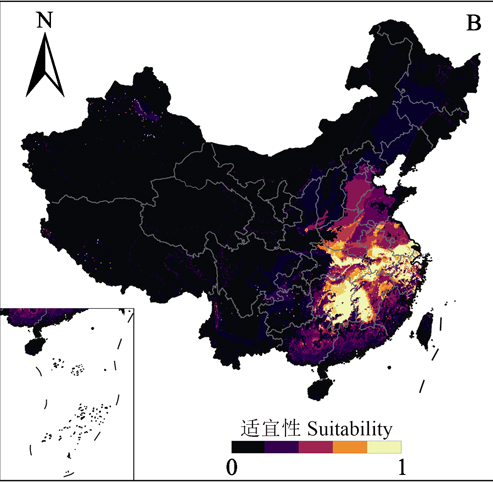
Uncertainty is inherent in ecological niche model predictions and different models yield different predictions. Based on the niche conservatism hypothesis, classic niche models that are calibrated on native areas and transferred to introduced areas for evaluation and prediction have advantages. Cabomba caroliniana is a notorious invasive aquatic weed native to South America that has established populations in China. In this study, independent testing points from China were used to validate and select the best individual model to predict the potential distribution, offering reliable and valuable information for risk analyses of C. caroliniana. The distributional records of C. caroliniana in China were sorted in chronological order, and climate niche dynamics and niche conservatism of C. caroliniana invasions across major continents were investigated using environmental variables associated with observed records. A total of 10 models were then calibrated in native area using two environmental datasets and five model algorithms. The best individual model was used to predict distribution, which was tested and selected based on the criteria of low omission and commission errors of independent introduced points. Results showed that present distribution of C. caroliniana occurs mainly along the eastern coastal areas of China. It has also dispersed northward in rivers and lakes system along Beijing-Hangzhou Grand Canal or South-to-North water diversions. The climate conditions occupied by different continental populations overlap broadly suggesting its climate niche was conserved during the invasion in China. There were many climate spaces that were unfilled when compared to its native niche spaces, suggesting a high invasion potential in these areas. Areas of potential distributions identified by best native individual model include Beijing, Shanghai, Shandong, Zhejiang, Jiangsu, Anhui, Hubei and Hunan provinces. These potential areas were mainly distributed in the southeastern rivers, lakes, canals and channels all with high human activity and no effective natural enemy, which could assist C. caroliniana expansion. Our research demonstrates the need for rigorous surveys in these areas, together with an integrative management action to control further expansion of C. caroliniana.
Cite this article
Fan Jingyu , Li Hanpeng , Yang Zhuo , Zhu Gengping . Selecting the best native individual model to predict potential distribution of Cabomba caroliniana in China[J]. Biodiversity Science, 2019 , 27(2) : 140 -148 . DOI: 10.17520/biods.2018232
References
| [1] | Bai YZ, Cao XF, Chen C, Hu BS, Liu FQ ( 2009) Potential distribution areas of alien invasive plant Flaveria bidentis (Asteraceae) in China. Chinese Journal of Applied Ecology, 20, 2377-2383. (in Chinese with English abstract) |
| [1] | [ 白艺珍, 曹向锋, 陈晨, 胡白石, 刘凤权 ( 2009) 黄顶菊在中国的潜在适生区. 应用生态学报, 20, 2377-2383.] |
| [2] | Breiner FT, Guisan A, Bergamini A, Nobis MP ( 2015) Overcoming limitations of modelling rare species by using ensembles of small models. Methods in Ecology and Evolution, 6, 1210-1218. |
| [3] | Brown JL ( 2014) SDMtoolbox: A python-based GIS toolkit for landscape genetic, biogeographic and species distribution model analyses. Methods in Ecology and Evolution, 5, 694-700. |
| [4] | Ding BY ( 1999) The first occurrence of Cabomba caroliniana A. Gray (Cabombaceae) in China. Journal of Hangzhou University (Nature Science), 26, 97. (in Chinese) |
| [4] | [ 丁炳扬 ( 1999) 绿菊花草在我国首次发现. 杭州大学学报(自然科学版), 26, 97.] |
| [5] | Ding BY ( 2000) Cabomba Aublet (Cabombaceae), a newly naturalized genus of China. Acta Phytotaxonomica Sinica, 38, 198-200. (in Chinese with English abstract) |
| [5] | [ 丁炳扬 ( 2000) 中国水生植物一新归化属——水盾草属(莼菜科). 植物分类学报, 38, 198-200.] |
| [6] | Ding BY, Jin XF, Yu MJ, Yu J, Shen HM, Wang YF ( 2007) Impact to native species by invaded subaqueous plant Cabomba caroliniana. Oceanologia et Limnologia Sinica, 38, 336-342. (in Chinese with English abstract) |
| [6] | [ 丁炳扬, 金孝锋, 于明坚, 余建, 沈海铭, 王月丰 ( 2007) 水盾草(Cabomba caroliniana)入侵对沉水植物群落物种多样性组成的影响. 海洋与湖沼, 38, 336-342.] |
| [7] | Ding BY, Yu MJ, Jin XF, Yu J, Jiang WM, Dong KF ( 2003) The distribution characteristics and invasive route of Cabomba caroliniana in China. Biodiversity Science, 11, 223-230. (in Chinese with English abstract) |
| [7] | [ 丁炳扬, 于明坚, 金孝锋, 余建, 姜维梅, 董柯锋 ( 2003) 水盾草在中国的分布特点和入侵途径. 生物多样性, 11, 223-230.] |
| [8] | Dong ZD, Shi LC, Huang GZ, Qin YC ( 2007) Investigation and countermeasure of plant invasion in Liuzhou. Guangxi Plant Protection, 20(2), 27-29. (in Chinese) |
| [8] | [ 董志德, 石亮成, 黄桂珍, 覃燕城 ( 2007) 柳州市生态灾害植物外侵种的调查与对策. 广西植保, 20(2), 27-29.] |
| [9] | Evans SN, Shvets Y, Slatkin M ( 2007) Non-equilibrium theory of the allele frequency spectrum. Theoretical Population Biology, 71, 109-119. |
| [10] | Fan JY, Zhao NX, Li M, Wang ML, Zhu GP ( 2018) What are the best predictors for invasive potential of weeds? Transferability evaluations of model predictions based on diverse environmental data sets for Flaveria bidentis. Weed Research, 58, 141-149. |
| [11] | He JX, Huang C, Wan FH, Guo JY ( 2011) Invasion and distribution of Cabomba caroliniana in wetlands of Jiangsu, China. Chinese Journal of Applied and Environmental Biology, 17, 186-190. (in Chinese with English abstract) |
| [11] | [ 何金星, 黄成, 万方浩, 郭建英 ( 2011) 水盾草在江苏省重要湿地的入侵与分布现状. 应用与环境生物学报, 17, 186-190.] |
| [12] | Hijmans RJ, Cameron SE, Parra JL, Jones PG, Jarvis A ( 2005) Very high resolution interpolated climate surfaces for global land areas. International Journal of Climatology, 25, 1965-1978. |
| [13] | Hou YT, Shu FY, Dong SX, Liu M, Xie SG ( 2012) Cabomba caroliniana, a new recorded exotic aquatic plant in Nansi Lake and its habitat characters. Acta Hydrobiologica Sinica, 36, 1005-1008. (in Chinese with English abstract) |
| [13] | [ 侯元同, 舒凤月, 董士香, 柳明, 谢松光 ( 2012) 水盾草——南四湖外来水生植物新记录及其生境特点. 水生生物学报, 36, 1005-1008.] |
| [14] | Peterson AT, Papeş M, Soberón J ( 2008) Rethinking receiver operating characteristic analysis applications in ecological niche modeling. Ecological Modelling, 213, 63-72. |
| [15] | Peterson AT, Cobos ME, Jiménez-García D ( 2018) Major challenges for correlational ecological niche model projections to future climate conditions. Annals of the New York Academy of Sciences, 1429, 66-77. |
| [16] | Peterson AT, Soberón J ( 2012) Species distribution modeling and ecological niche modeling: Getting the concepts right. Brazilian Journal for Nature Conservation, 10, 1-6. |
| [17] | Petitpierre B, Kueffer C, Broennimann O, Randin C, Daehler C, Guisan A ( 2012) Climatic niche shifts are rare among terrestrial plant invaders. Science, 335, 1344-1348. |
| [18] | Qiao HJ, Peterson AT, Campbell LP, Soberón J, Ji LQ, Escobar LE ( 2016) NicheA: Creating virtual species and ecological niches in multivariate environmental scenarios. Ecography, 39, 805-813. |
| [19] | Qiao HJ, Feng X, Escobar LE, Peterson AT, Soberón J, Zhu GP, Papeş M ( 2018) An evaluation of transferability of ecological niche models. Ecography, 30, 550-560. |
| [20] | Shen ZH ( 2000) Cabomba caroliniana—New invasive alien species. Life World, ( 2), 37-38. (in Chinese) |
| [20] | [ 沈脂红 ( 2000) 水盾草——新入侵的外来种. 生命世界, ( 2), 37-38.] |
| [21] | Soberón J , Nakamura ( 2009) Niches and distributional areas: Concepts, methods and assumptions. Proceedings of the National Academy of Sciences, USA, 106, 19644-19650. |
| [22] | Thuiller W ( 2003) BIOMOD—Optimizing predictions of species distributions and projecting potential future shifts under global change. Global Change Biology, 9, 1353-1362. |
| [23] | Tingley R, Meiri S, Chapple DG ( 2016) Addressing knowledge gaps in reptile conservation. Biological Conservation, 204, 1-5. |
| [24] | Uden DR, Allen CR, Angeler DG, Corral LL, Fricke K ( 2015) Adaptive invasive species distribution models: A framework for modeling incipient invasions. Biological Invasions, 17, 2831-2850. |
| [25] | Wan ZG, Gu YJ, Qian SX ( 1999) Cabomba Aubl. of Nymphaeaceae, a new record genus from China. Journal of Wuhan Botanical Research, 17, 215-216. (in Chinese with English abstract) |
| [25] | [ 万志刚, 顾咏洁, 钱士心 ( 1999) 中国睡莲科一新记录属——水盾草属. 武汉植物学研究, 17, 215-216.] |
| [26] | Warren DL, Beaumont L, Dinnage R, Baumgartner J ( 2018) New methods for measuring ENM breadth and overlap in environmental space. Ecography, 42, 444-446. |
| [27] | Xu CY, Zhang WJ, Lu BR, Chen JK ( 2001) Progress in studies on mechanisms of biological invasion. Biodiversity Science, 9, 430-438. (in Chinese with English abstract) |
| [27] | [ 徐承远, 张文驹, 卢宝荣, 陈家宽 ( 2001) 生物入侵机制研究进展. 生物多样性, 9, 430-438.] |
| [28] | Yates KL, Bouchet PJ, Caley M, Mengersen K, Randin CF, Parnell S, Fielding AH, Bamford AJ, Ban S, Barbosa AM, Dormann CF, Elith J, Embling CB, Ervin GN, Fisher R, Gould S, Graf RF, Gregr EJ, Sequeira AMM ( 2018) Outstanding challenges in the transferability of Ecological Models. Trends in Ecology and Evolution, 33, 790-802. |
| [29] | Zhang JL, Meng SY ( 2013) Cabomba caroliniana A. Gray found in Beijing water areas. Weed Science, 31(2), 45-46. (in Chinese) |
| [29] | [ 张劲林, 孟世勇 ( 2013) 北京水域发现水盾草. 杂草科学, 31(2), 45-46.] |
| [30] | Zhang Q ( 2012) The aquatic plant of Cabomba caroliniana. Garden, ( 8), 74-75. (in Chinese) |
| [30] | [ 张群 ( 2012) 水生植物水盾草. 园林, ( 8), 74-75.] |
| [31] | Zhu GP, Fan JY, Wang ML, Chen M, Qiao HJ ( 2017) The importance of the shape of receiver operating characteristic (ROC) curve in ecological model evaluation—Case study of Hlyphantria cunea. Journal of Biosafety, 26, 184-190. (in Chinese with English abstract) |
| [31] | [ 朱耿平, 范靖宇, 王梦琳, 陈敏, 乔慧捷 ( 2017) ROC曲线形状在生态位模型评价中的重要性——以美国白蛾为例. 生物安全学报, 26, 184-190.] |
| [32] | Zhu GP, Gariepy TD, Haye T, Bu WJ ( 2017) Patterns of niche filling and expansion across the invaded ranges of Halyomorpha halys in North America and Europe. Journal of Pest Science, 90, 1045-1057. |
| [33] | Zhu GP, Liu GQ, Bu WJ, Gao YB ( 2013) Ecological niche modeling and its applications in biodiversity conservation. Biodiversity Science, 21, 90-98. (in Chinese with English abstract) |
| [33] | [ 朱耿平, 刘国卿, 卜文俊, 高玉葆 ( 2013) 生态位模型的基本原理及其在生物多样性保护中的应用. 生物多样性, 21, 90-98.] |
| [34] | Zhu GP, Liu Q, Gao YB ( 2014) Improving ecological niche model transferability to predict the potential distribution of invasive exotic species. Biodiversity Science, 22, 223-230. (in Chinese with English abstract) |
| [34] | [ 朱耿平, 刘强, 高玉葆 ( 2014) 提高生态位模型转移能力来模拟入侵物种的潜在分布. 生物多样性, 22, 223-230.] |
| [35] | Zhu GP, Peterson T ( 2017) Do consensus models outperform individual models? Transferability evaluations of diverse modeling approaches for an invasive moth. Biological Invasions, 19, 2519-2532. |
| [36] | Živković D, Stephan W ( 2011) Analytical results on the neutral non-equilibrium allele frequency spectrum based on diffu?sion theory. Theoretical Population Biology, 79, 184-191. |