The color preference of bumblebee nectar robbing and its impact on the reproductive fitness of Lonicera calcarata
- 1 College of Life Sciences, Guizhou Normal University, Guiyang 550025, China
2 Key Laboratory of Plant Physiology and Development of Guizhou Province, Guizhou Normal University, Guiyang 550025, China
3 Key Laboratory of Southwest Karst Mountain Biodiversity Conservation of National Forestry and Grassland Administration, Guizhou Normal University, Guiyang 550025, China
Received date: 2024-12-09
Accepted date: 2025-03-03
Online published: 2025-03-10
Supported by
National Natural Science Foundation of China(32360262);National Natural Science Foundation of China(31901208);Guizhou Provincial Program on Commercialization of Scientific and Technological Achievements([2022]010);Water-Fertilizer Coupling and Biodiversity Restoration in Karst Rocky Desertification(QianJiaoJi [2023]004)
Abstract
Aims:The color change of flowers during their blooming process can serve as a cue that guides pollinators to preferentially visit pre-change color flowers. However, it remains unclear whether this color change influences nectar robbers’ behavior.
Methods:To explore whether nectar robbers prefer pre-change color flowers and the impact of nectar robbing on plant reproductive success, we used Lonicera calcarata (Caprifoliaceae) as the study subject. Its flowering period lasts for three days, during which the flower color changes from white to yellow and then to orange-red. We recorded the visitation behavior of flower-visiting insects in the field and calculated the frequencies of legitimate visits and nectar robbing. We also analyzed the nectar robbing rates of flowers of three colors in different populations, measured the morphological traits of normal and robbed flowers, assessed the nectar volume and sugar concentration in both normal and robbed flowers during blooming, and examined the total number of pollen grains and ovules in flower buds from normal and robbed flowers. Finally, we performed different artificial pollination treatments to calculate seed set.
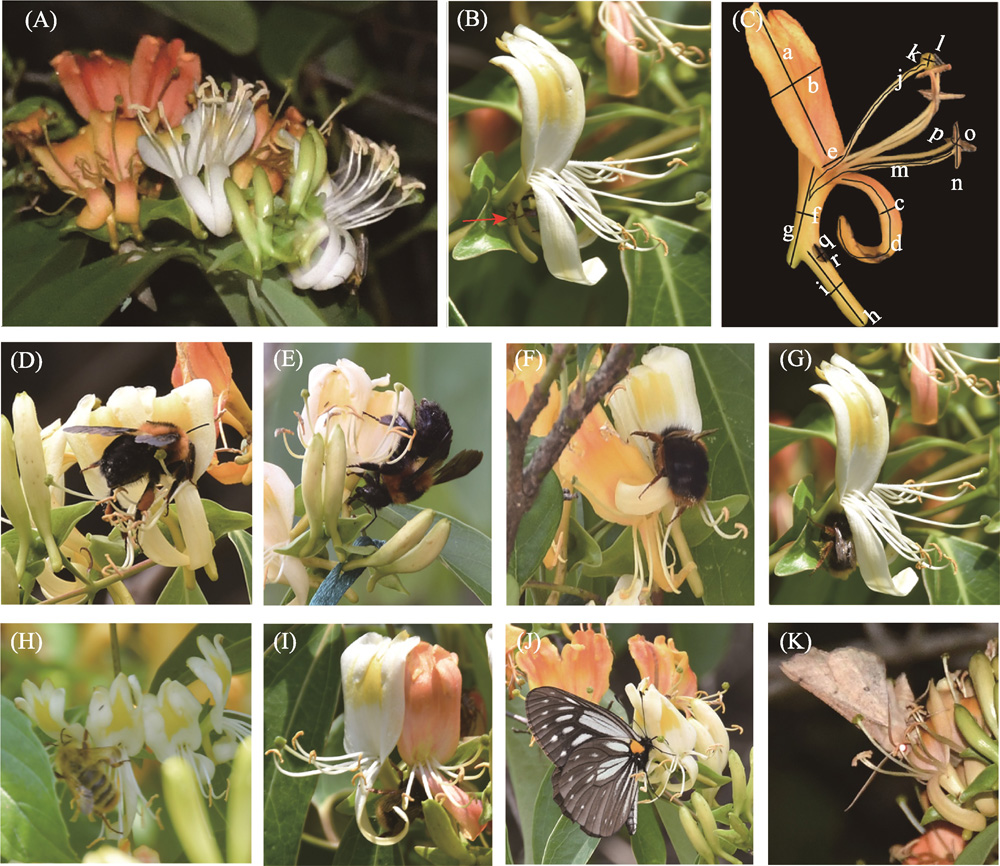
Results:Flower visitors to L. calcarata included moths, butterflies, and bumblebees, among which bumblebees could both legitimately visit the flowers and rob nectar from flowers of different colors. The overall nectar robbing frequency was higher than the frequency of legitimate visits for bumblebees. Nectar robbing rates of L. calcarata varied across different populations, with the nectar robbing rate of orange-red and yellow flowers being significantly higher than that of white flowers. The floral traits of robbed flowers were smaller than normal flowers in general, especially the lip and anther size. The holes in nectar spurs of orange-red and yellow flowers were significantly larger than those in white flowers. In all the three phases, nectar robbing significantly reduced the nectar volume of one flower, but did not affect the nectar sugar concentration. There were no significant differences in the total number of pollen grains in the buds between robbed and normal flower, as well as the ovules. Seed sets of pollen grains from normal and robbed flowers pollinated on the stigmas of normal flowers were not significantly different. Likewise, the seed sets of pollen from normal flowers pollinated on the stigma of normal and robbed flowers showed no significant differences.
Conclusion:This study preliminarily indicates that nectar robbing bees, particularly bumblebees, do not preferentially visit pre-change color flowers. Nectar robbing reduces nectar secretion and it does not directly affect the plant’s female and male fitness. The influence of flower color change on flower-visiting insect behavior requires further and more sustained investigation.
Cite this article
Wang Shunyu , Li Yang , Lü Xiaoqin , Li Xin , Fan Quanxiu , Wang Xiaoyue . The color preference of bumblebee nectar robbing and its impact on the reproductive fitness of Lonicera calcarata[J]. Biodiversity Science, 2025 , 33(4) : 24554 . DOI: 10.17520/biods.2024554
References
| [1] | Carrió E, Güemes J (2019) Nectar robbing does not affect female reproductive success of an endangered Antirrhinum species, Plantaginaceae. Plant Ecology & Diversity, 12, 159-168. |
| [2] | de Souza CV, Salvador MV, Tunes P, Di Stasi LC, Guimar?es E (2019) I’ve been robbed! Can changes in floral traits discourage bee pollination? PLoS ONE, 14, e0225252. |
| [3] | Deng H, Xiang GJ, Guo YH, Yang CF (2017) Study on the breeding system and floral color change of four Lonicera species in the Qinling Mountains. Plant Science Journal, 35, 1-12. (in Chinese with English abstract) |
| [邓惠, 向甘驹, 郭友好, 杨春锋 (2017) 秦岭忍冬属4种植物的繁育系统及花色变化的研究. 植物科学学报, 35, 1-12.] | |
| [4] | Eidesen PB, Little L, Müller E, Dickinson KJM, Lord JM (2017) Plant-pollinator interactions affect colonization efficiency: Abundance of blue-purple flowers is correlated with species richness of bumblebees in the Arctic. Biological Journal of the Linnean Society, 121, 150-162. |
| [5] | Feng HH, Wang XY, Luo YB, Huang SQ (2023) Floral scent emission is the highest at the second night of anthesis in Lonicera japonica(Caprifoliaceae). Journal of Systematics and Evolution, 61, 530-537. |
| [6] | Hazlehurst JA, Karubian JO (2016) Nectar robbing impacts pollinator behavior but not plant reproduction. Oikos, 125, 1668-1676. |
| [7] | Heiling JM, Ledbetter TA, Richman SK, Ellison HK, Bronstein JL, Irwin RE (2018) Why are some plant-nectar robber interactions commensalisms? Oikos, 127, 1679-1689. |
| [8] | Hou QZ, Ehmet N, Chen DW, Wang TH, Xu YF, Ma J, Sun K (2021) Corolla abscission triggered by nectar robbers positively affects reproduction by enhancing self-pollination in Symphytum officinale(Boraginaceae). Biology, 10, 903. |
| [9] | Inouye DW (1983) The ecology of nectar robbing. In: The Biology of Nectaries (eds Bentley B, Elias T), pp. 153-173. Columbia University Press, New York. |
| [10] | Irwin RE, Brody AK (1999) Nectar-robbing bumble bees reduce the fitness of Ipomopsis aggregata(Polemoniaceae). Ecology, 80, 1703-1712. |
| [11] | Irwin RE, Bronstein JL, Manson JS, Richardson L (2010) Nectar robbing: Ecological and evolutionary perspectives. Annual Review of Ecology, Evolution, and Systematics, 41, 271-292. |
| [12] | Irwin RE, Howell P, Galen C (2015) Quantifying direct vs. indirect effects of nectar robbers on male and female components of plant fitness. Journal of Ecology, 103, 1487-1497. |
| [13] | Irwin RE, Maloof JE (2002) Variation in nectar robbing over time, space, and species. Oecologia, 133, 525-533. |
| [14] | Li JJ, Lian XY, Ye CL, Wang L (2019) Analysis of flower color variations at different developmental stages in two honeysuckle (Lonicera japonica Thunb.)cultivars. HortScience, 54, 779-782. |
| [15] | Mackin CR, Goulson D, Castellanos MC (2021) Novel nectar robbing negatively affects reproduction in Digitalis purpurea. Ecology and Evolution, 11, 13455-13463. |
| [16] | Maidana-Tuco YN, Larrea-Alcázar DM, Pacheco LF (2024) Nectar robbing effects on pollinators of a key nectar source plant (Tecoma fulva, Bignoniaceae) in a dry tropical Andean valley. Biotropica, 56, e13319. |
| [17] | Makino TT, Ohashi K (2017) Honest signals to maintain a long-lasting relationship: Floral colour change prevents plant-level avoidance by experienced pollinators. Functional Ecology, 31, 831-837. |
| [18] | Maloof JE (2001) The effects of a bumble bee nectar robber on plant reproductive success and pollinator behavior. American Journal of Botany, 88, 1960-1965. |
| [19] | Ohashi K, Makino TT, Arikawa K (2015) Floral colour change in the eyes of pollinators: Testing possible constraints and correlated evolution. Functional Ecology, 29, 1144-1155. |
| [20] | Raine NE, Chittka L (2007) Flower constancy and memory dynamics in bumblebees (Hymenoptera: Apidae: Bombus). Entomologia Generalis, 29, 179-199. |
| [21] | Richman SK, Barker JL, Baek M, Papaj DR, Irwin RE, Bronstein JL (2021) The sensory and cognitive ecology of nectar robbing. Frontiers in Ecology and Evolution, 9, 698137. |
| [22] | Rojas-Nossa SV, Sánchez JM, Navarro L (2016) Effects of nectar robbing on male and female reproductive success of a pollinator-dependent plant. Annals of Botany, 117, 291-297. |
| [23] | Rojas-Nossa SV, Sánchez JM, Navarro L (2021) Nectar robbing and plant reproduction: An interplay of positive and negative effects. Oikos, 130, 601-608. |
| [24] | Sun SG, Liao K, Xia J, Guo YH (2005) Floral colour change in Pedicularis monbeigiana(Orobanchaceae). Plant Systematics and Evolution, 255, 77-85. |
| [25] | Tie S, He YD, Lázaro A, Inouye DW, Guo YH, Yang CF (2023) Floral trait variation across individual plants within a population enhances defense capability to nectar robbing. Plant Diversity, 45, 315-325. |
| [26] | Traveset A, Willson MF, Sabag C (1998) Effect of nectar-robbing birds on fruit set of Fuchsia magellanica in Tierra Del Fuego: A disrupted mutualism. Functional Ecology, 12, 459-464. |
| [27] | Varma S, Rajesh TP, Manoj K, Asha G, Jobiraj T, Sinu PA (2020) Nectar robbers deter legitimate pollinators by mutilating flowers. Oikos, 129, 868-878. |
| [28] | Wang XY, Yao RX, Lv XQ, Yi Y, Tang XX (2023) Nectar robbing by bees affects the reproductive fitness of the distylous plant Tirpitzia sinensis(Linaceae). Ecology and Evolution, 13, e10714. |
| [29] | Weiss MR (1991) Floral colour changes as cues for pollinators. Nature, 354, 227-229. |
| [30] | Weiss MR, Lamont BB (1997) Floral color change and insect pollination: A dynamic relationship. Israel Journal of Plant Sciences, 45, 185-199. |
| [31] | Willmer P (2011) Pollination and Floral Ecology. Princeton University Press, Princeton. |
| [32] | Yang QE, Sven L, Joanna O, Renata B (2011) Lonicera. In: Flora of China, Vol. 19 (eds Wu ZY, Raven PH, Hong DY), pp. 620-641. Science Press, Beijing & Missouri Botanical Garden Press, St. Louis. |
| [33] | Ye ZM, Jin XF, Wang QF, Yang CF, Inouye DW (2017) Nectar replenishment maintains the neutral effects of nectar robbing on female reproductive success of Salvia przewalskii (Lamiaceae), a plant pollinated and robbed by bumble bees. Annals of Botany, 119, 1053-1059. |
| [34] | Zhang YW, Wang Y, Guo YH (2006) The effects of nectar robbing on plant reproduction and evolution. Journal of Plant Ecology (Chinese Version), 30, 695-702. (in Chinese with English abstract) |
| [张彦文, 王勇, 郭友好 (2006) 盗蜜行为在植物繁殖生态学中的意义. 植物生态学报, 30, 695-702.] | |
| [35] | Zhu XF, Wan JP, Li QJ (2010) Nectar robbers pollinate flowers with sexual organs hidden within corollas in distylous Primula secundiflora (Primulaceae). Biology Letters, 6, 785-787. |
| [36] | Zimmerman M, Cook S (1985) Pollinator foraging, experimental nectar-robbing and plant fitness in Impatiens capensis. American Midland Naturalist, 113, 84. |